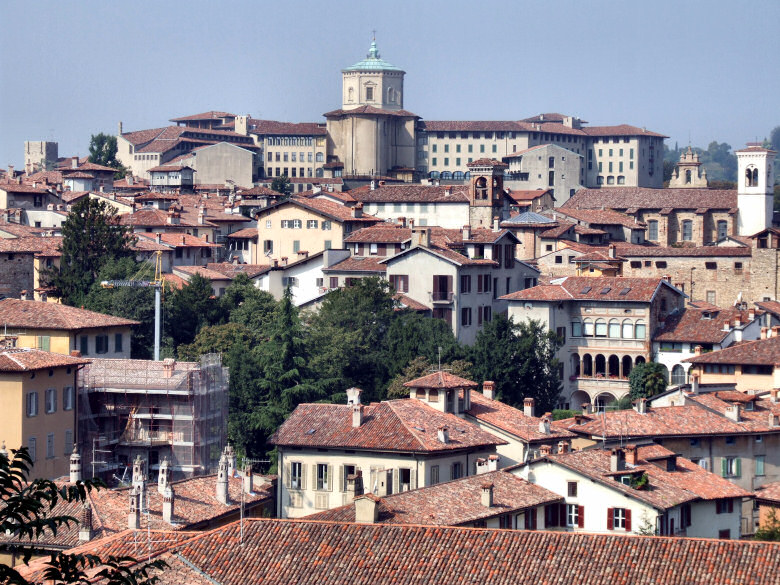
Episcopal Seminary - Courtyards - Bergamo
Europe,
Italy,
Bergamo,
The Bishop’s Seminary, established between the 18th and 19th centuries, is an important training center for clergy and an icon of the city’s religious identity. It is known for its elegant architecture and for being a landmark in the ecclesiastical life of Bergamo. The construction of the seminary dates back to 1775, and since then it has undergone numerous changes and restorations, becoming an increasingly significant symbol of local culture. Its presence tells stories of faith, education, and architecture that continue to thrive within its spaces.Origins and HistoryThe history of the Bishop’s Seminary of Bergamo begins in 1775 when Bishop Giovanni Battista Rota decided to establish a place for the formation of clergy. This initiative arose from the need to train well-prepared priests during a time when the Catholic Church was experiencing significant changes, partly due to the spread of Enlightenment ideas.The original building was located in what was then a decentralized area of the city. Its construction was entrusted to architect Giovanni Battista Caniana, who designed a sober yet refined structure in line with the principles of neoclassical architecture, characterized by clean lines and a sense of balance. The seminary was designed to accommodate both the ecclesiastical community and the students, creating an environment conducive to study and spirituality.In 1805, the seminary was expanded under the direction of another architect, Giuseppe Cottini, who added new spaces for classrooms and dormitories. These subsequent interventions not only enhanced the functionality of the seminary but also enriched its architectural appearance, making it a key element of Bergamo’s urban landscape.During the 19th century, the Bishop’s Seminary was again expanded and renovated. After World War II, the seminary underwent further renewal, reflecting the new educational needs of the Church. The restorations were carried out with attention to historical elements while enhancing the existing architecture, aiming to create a contemporary space for priestly formation.Today, the Bishop’s Seminary of Bergamo is an active place that continues to host training courses for future priests, keeping alive the spiritual and cultural traditions of the local community.What to ObserveEntering the seminary, you will be welcomed by an atmosphere of tranquility and meditation. On the left side, you might notice the library. This space, evocative and well-stocked, houses a vast collection of sacred texts and theological works, reflecting the educational intent of the seminary.Continuing on, observe the central courtyard: an architectural element of great significance. Its design was conceived to create a meeting point for students, fostering social and spiritual relationships. The elegant and proportioned arches that surround it are an example of the neoclassicism that permeates the entire building. This courtyard is a place of peace, perfect for reflection and gatherings.As you continue your visit, you shouldn’t miss the cloister, located to your right. Characterized by stone columns and semicircular arches, it represents a perfect balance between functionality and understated beauty. This space was designed to bring light and air into the interior corridors, contributing to a serene atmosphere, ideal for meditation.The Bishop’s Palace, also connected to the seminary, stands next to the main building. Built in later periods, it houses numerous works of art that tell the story of the Diocese of Bergamo. Its facade is decorated with frescoes and reliefs depicting biblical scenes, a constant visual reference to the spirituality that pervades these places.Another element to observe is the internal chapels. These small churches, scattered throughout the seminary, serve as places of worship and prayer for the students. Each chapel has its own style and decorations, making them unique. Here, you can appreciate details like stained glass windows and altars, which are artistic expressions from various historical periods that have marked the seminary’s life.Not far from the courtyards, there is also a garden. This green space was designed as a place for meditation and contemplation, offering a panoramic view of the city. It is in this natural corner that clergy and students can find a moment of tranquility, immersed in an atmosphere that combines spirituality and natural beauty.Finally, you may notice some temporary exhibitions hosted in the seminary’s halls. These displays, which vary throughout the year, provide an overview of local artists and works that reflect the cultural heritage of Bergamo. In this way, the seminary is not just a place of religious formation but also a center for cultural dialogue.Context and ConnectionsThe Bishop’s Seminary is located in the heart of Bergamo’s upper town, an area rich in history and art. The neighborhood is characterized by cobblestone streets and historic buildings that recount the city’s long cultural tradition. Nearby stands the famous Cathedral of Bergamo, dedicated to Saint Alexander, another important place of worship that attracts visitors from all over the world.Additionally, not far away is the Accademia Carrara, one of the most important art galleries in Lombardy, known for its collections of Renaissance and Baroque works. Its proximity to the seminary offers a dual opportunity for discovery, combining art and faith in a single path.Finally, the square also overlooks the Rocca of Bergamo, a historical fortification that offers an unmissable view of the city and its surroundings. This interaction between the sacred and the profane, between art and history, further enriches the visit, inviting every pilgrim and visitor to explore and deepen their knowledge of Bergamo’s rich heritage.CuriositiesThe seminary’s library, besides being a place of study, is also an important historical archive. It contains documents dating back to the time of the seminary’s foundation, testifying to the transformations of the Church and of Bergamo’s society over the centuries.Another interesting fact concerns the seminary’s garden. During its design, there was a desire to preserve the native flora, using typical plants of the region, thus creating a habitat that promotes biodiversity.Finally, the Bishop’s Seminary has played a significant role in the events of the diocese’s life. Here, annual liturgical celebrations and training meetings are held, continuing to keep the ecclesiastical tradition alive, linking the present with a glorious historical past.A visit to the Bishop’s Seminary of Bergamo is just the beginning of a fascinating journey in the upper town. We invite you to discover nearby the Cathedral of Bergamo and the Accademia Carrara, two places that will further enrich your experience and immerse you in the history and culture of this beautiful city.
Read More