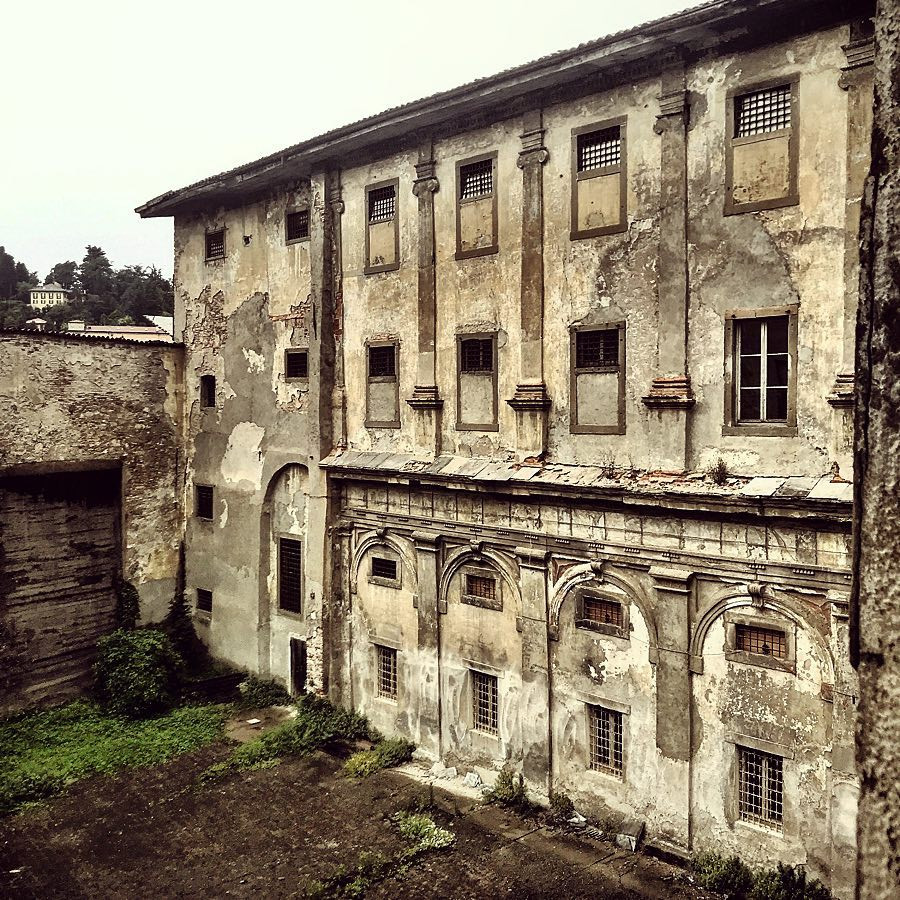
Former Prisons of Sant'Agata - Bergamo
Europe,
Italy,
Bergamo,
The Ex Carceri di Sant’Agata, located in the heart of Bergamo, represent an important piece of the city’s complex historical identity. These buildings, dating back to the medieval period, are known for having been a significant place of detention and rehabilitation from the 16th century until their closure in 1990. Today, the former prison is a significant example of the transformation of public spaces and the recovery of historical memory. Their existence, visible in the context of the upper city, tells stories of men and women who lived through the harsh living conditions of that time. Their restoration has given rise to new cultural functions, making this structure a place of meeting and reflection.Origins and HistoryThe Ex Carceri di Sant’Agata were built in 1584 at the behest of the Republic of Venice, which governed Bergamo at that time. The decision to create a detention house was determined by the need to repress and control crimes in an expanding society. The strategic position of the structure, situated near the city walls, allowed for easy access and effective surveillance. The facade, characterized by Renaissance architectural styles, overlooked one of the main thoroughfares of the time, symbolizing authority and justice.Over the centuries, the complex underwent various transformations. In 1821, the prison was restored and expanded by the architect Giacomo Quarenghi, who contributed to the efficiency of the spaces by integrating new cells and service areas. Another renewal occurred in 1894 when the prison underwent further restructuring to adapt to modern detention needs. This process saw the construction of a series of new cells and the introduction of sanitary facilities, elements considered innovative for the time.The Ex Carceri di Sant’Agata remained in operation until the 1990s when the Italian government decided to close obsolete prison facilities. This marked the beginning of a new chapter for the building. With abandonment, the structure risked becoming an urban decay, but in 2004, a project for cultural and historical recovery was launched. The renovation work has transformed the former prisons into multifunctional spaces dedicated to cultural activities, exhibitions, and public meetings.Today, the Ex Carceri di Sant’Agata are not just a memory of the past, but also a symbol of rebirth. The redevelopment has breathed new life into these places, making them accessible to everyone and transforming them into centers of aggregation and culture in the upper city of Bergamo.What to ObserveNow that you are in front of the former prison, let’s start our visit. As soon as you enter the structure, notice the main facade, characterized by elegant symmetry. At the top, you can see a coat of arms that refers to the rulers of the Venetian era. This decorative element is a clear reminder of the power exercised over the region.Continuing, to your left, you will find a large inner courtyard. This space, once used for the prisoners’ walks, now hosts events and exhibitions. The walls surrounding it still bear the marks of the past, telling stories of life and hope.At this point, let’s move towards the cells, which are still partially visible. Each small cell captivates with its harsh design, revealing what daily life was like for the prisoners. The thick, cold stone walls contributed to creating an atmosphere of isolation. In the corners, you can still see the small windows that, although they offered little light, once represented the only contact with the outside world.Continuing along our path, to your right is the confessional area, used for the spiritual support of the detainees. During their detention, many prisoners sought comfort in religion, and this small space symbolizes that search for redemption that marked life inside the walls.A significant element to observe is the main staircase that leads to the upper floors of the prison. This staircase, with its typical architectural style, had both a functional and symbolic importance, facilitating access to various parts of the structure.If you gaze up at the ceiling, you will notice some decorations that, although rough, reveal artistic details that have been preserved over time. These works speak to us of an era when prison life was accompanied by a certain dignity, even while imprisoned under adverse circumstances.Finally, you might find it interesting to visit the small museum set up inside. Here, historical documents and artifacts will allow you to delve deeper into the history of the former prison, immersing you in the historical memory of Bergamo and its cultural heritage.Context and ConnectionsThe Ex Carceri di Sant’Agata is set within an urban context rich in history and culture. We are indeed in the Upper City of Bergamo, an area declared a UNESCO World Heritage Site. Around these historic walls, you can find many other icons of the city, such as Piazza Vecchia, considered the beating heart of city life.Nearby is the Basilica of Santa Maria Maggiore, a masterpiece of Romanesque architecture with Gothic influences, attracting visitors from all over the world. Not far away, follow the call of the Cathedral of Bergamo, another place of significant artistic and spiritual value that deserves a thorough visit.Another noteworthy attraction is the Venetian Walls that surround the upper city. These defensive constructions, dating back to the era of the Republic of Venice, offer not only a testimony to military history but also breathtaking views of the underlying valley.In conclusion, a visit to the Ex Carceri di Sant’Agata is an opportunity not only to learn about the history of an emblematic place, but also to discover the cultural wealth that surrounds this corner of Bergamo. We invite you to continue your exploration of the city to uncover more stories and wonders that it has to offer.CuriositiesFor those who love discovering unknown details, here are some curiosities related to the Ex Carceri di Sant’Agata. The structure, during its period of activity, housed famous prisoners, including historical figures who contributed to shaping the identity of the city. Many of them, after their detention, returned to live in the community, sharing their experiences and influencing local culture.An interesting aspect is that during its closure, the former prison was considered a site for urban art. Various local and non-local artists found in those abandoned walls a canvas to express their creativity, turning the reality of the former prison into a symbol of rebirth and hope.Finally, did you know that the former prison has hosted numerous cultural initiatives? Concerts, art exhibitions, and conferences have taken place in these spaces, demonstrating that even places with heavy histories can be reborn through culture.
Read More