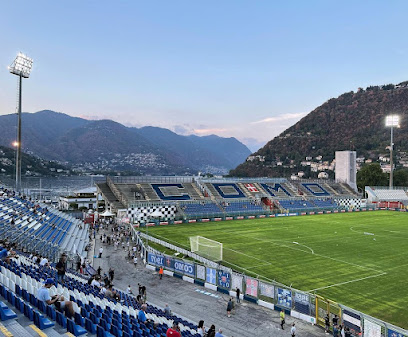
Giuseppe Sinigaglia Stadium, Como
Europe,
Italy,
Como,
Welcome to the audio guide dedicated to the Giuseppe Sinigaglia Stadium, an important sports and cultural landmark of the city of Como. Located in a strategic position near the lake, this stadium is famous not only for its sports function but also for its connection to local history and architecture. Inaugurated in 1927, the stadium hosts matches for the Como football team and represents a symbol of the city’s sporting identity. Today, let’s explore together the origins, history, and peculiarities of this fascinating facility. The Giuseppe Sinigaglia Stadium was inaugurated on October 23, 1927, with a match between Como and Novara. The construction took place during a period when Italy was experiencing significant urban and sporting development, with the idea of promoting nationally relevant sporting events. The name of the stadium pays tribute to Giuseppe Sinigaglia, a talented footballer from Como who played in the pre-war era, highlighting the strong bond between the club and the territory. In the years following its inauguration, the stadium has undergone several renovation interventions. One of the most significant occurred in 1950, when the stands were expanded and facilities for fans were improved. In 1983, a new renovation gave the stadium a more modern appearance, adapting it to contemporary needs. It is interesting to note that the capacity of the Sinigaglia has varied over time: originally, it could hold up to 20,000 spectators, while today its capacity is around 13,000 seats. It’s not just the sports function that makes this stadium important. It has witnessed historical events, such as matches of the Italian National Football Team and numerous high-level encounters in the football landscape. Throughout its history, the stadium has served as a gathering place for the Como community, a true “temple of football” that has seen generations of fans grow. At the entrance of the stadium, you are greeted by an imposing facade, simple yet functional, reflecting the sports architecture of the 1920s. The entrance features a large arch, a symbol of access to a world of passion and competition. When standing before this arch, take a moment to observe the stone details and the Como logo, a symbol of a long tradition. Once you pass through the gate, the first thing that strikes you is the playing field, visible from most points in the stadium. The quality of the grass has been carefully tended to ensure high standards of play. The field is surrounded by an athletics track, which has also hosted athletics events over time. Inside the stadium, on the left, you can notice the main stand. This area is dedicated not only to fans but also to special guests and members of the press. The stand is equipped with red and blue seats, the colors of Como. The choice of these colors is not casual; they represent the strong connection of the team to the city and its history. Continuing the tour, I suggest you take a stroll around the area of the side stands. Here you can notice various murals and artwork dedicated to the history of football in Como, curated by local artists. These artistic interventions give a unique and personal touch to a space otherwise dedicated exclusively to sports activity. As you move to the public service area, you can observe how the stadium has been able to adapt to modern times. Within the covered areas, there are refreshment points and small shops selling team merchandise. These spaces not only enhance the convenience for fans but also create a strong identity for the club, engaging visitors in an experience that goes beyond the simple match. Finally, although not always visible, the panorama surrounding the stadium is a true wonder. Located just steps from the shores of Lake Como, it offers unique glimpses of natural beauty. In this regard, if you look out from one of the open sides of the stadium, you might catch sight of the lake and the mountains that surround it, a setting that further enriches the experience. The Giuseppe Sinigaglia Stadium is not just a sports facility, but it perfectly fits into the cultural and social context of Como. Located in the part of the city that overlooks the lake, it is easily accessible and well connected with other important local institutions. A short walk from the stadium, you’ll find the Lido di Villa Olmo, a recreational and relaxation area that attracts both local visitors and tourists. This place represents a perfect contrast to the liveliness of sporting action, offering a space to enjoy the beauty of the lake. The villa itself, dating back to the 18th century, hosts artistic and cultural events throughout the year, creating a synergy between sport and culture. Another nearby attraction is the Voltiano Temple, dedicated to Alessandro Volta, the famous scientist from Como. This museum, with its neoclassical architecture and historical reconstructions, showcases Como’s strong connection to science and innovation. Visiting this museum after a match at the Sinigaglia can offer a more complete picture of the city’s excellence. In addition to its function as a stadium, the Giuseppe Sinigaglia has hosted non-football events, such as concerts and cultural events, making it a multifunctional gathering place. Additionally, Como Calcio was founded in 1907 and plays in the Serie C league, an important category in the Italian football landscape. Throughout its history, the stadium has also witnessed moments of sporting tension and fierce rivalries, not only on the field but also among fans. These elements have contributed to shaping the local football culture. Lastly, it is worth noting that the Sinigaglia Stadium overlooks one of the most beautiful landscapes in Italy, Lake Como, often described by travelers as a “heavenly paradise” for its breathtaking beauty and crystal-clear waters. We conclude our tour by inviting you to discover the surroundings of the stadium: the Lido di Villa Olmo and the Voltiano Temple are just a few of the fascinating attractions Como has to offer, carrying on a tradition of beauty and sport that is worth experiencing. Enjoy your visit!
Read More