Golden Tower
Europe,
Spain,
Seville,
El Arenal
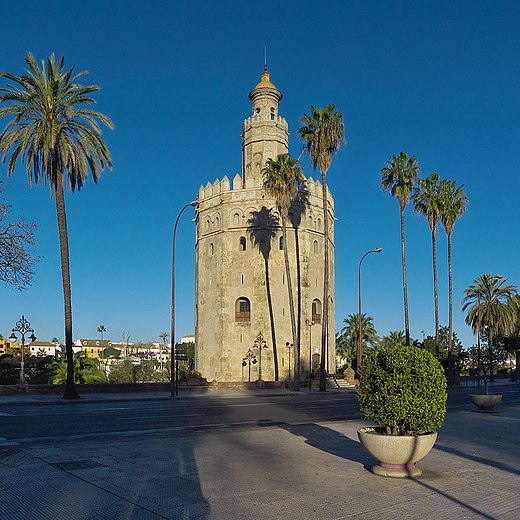
The Torre del Oro in Seville, one of the most recognizable symbols of the city, is a military control tower erected on the banks of the Guadalquivir River. Built between 1220 and 1221 by order of the Almohad caliph Abu Ya’qub Yusuf II, the tower was intended to control the river access to the city. With its dodecagonal structure and a height of 36 meters, the tower is a fascinating example of Mudéjar architecture.
The tower is composed of three main sections. The first, the dodecagonal base, was built in the 13th century and served as an integral part of the city’s defensive walls. The second section, also dodecagonal, was added in the 14th century under the reign of Peter I of Castile. The third and final section, cylindrical in shape and topped with a dome, was built in 1760 by the military engineer Sebastian Van der Borcht, the same who designed the Real Fábrica de Tabacos.The name “Torre del Oro” probably derives from the golden glow that the tower reflected on the river, an effect achieved thanks to an original coating of golden azulejos. However, during the 2005 restoration, it was discovered that this glow was due to a mixture of mortar, lime, and pressed straw.The main function of the Torre del Oro was to defend the city from enemy attacks. It was part of the complex defensive system of the Alcázar and the city walls, and could block the passage of enemy ships by a chain that crossed the river. This system was used during the Reconquista in 1248, when the Castilian fleet under the command of Ramón de Bonifaz attacked Seville.Over the centuries, the tower has had various uses. During the Middle Ages, it was transformed into a chapel dedicated to Saint Isidore of Seville and later used as a prison. During the colonial period, it was used as a warehouse for precious metals imported from the Americas.The Torre del Oro suffered serious damage during the Lisbon earthquake of 1755, but was saved from demolition thanks to the opposition of the local population. In 1760, the tower was reinforced and expanded, taking on its current appearance. Throughout the 20th century, the tower has been declared a historic-artistic monument and has undergone several restorations to preserve its integrity.Today, the Torre del Oro houses the Naval Museum of Seville, which tells the rich maritime history of the city. The museum contains a vast collection of engravings, letters, ship models, tools, and historical documents. Through these exhibitions, visitors can explore Seville’s naval past and understand the strategic importance of the Guadalquivir River.The architecture of the tower is an example of beauty and functionality. The dodecagonal base provides stability to the structure, while the upper cylindrical section adds a touch of elegance. The top dome offers a spectacular panoramic view of the city and the river, making the Torre del Oro a must-visit for those exploring Seville.
Read More