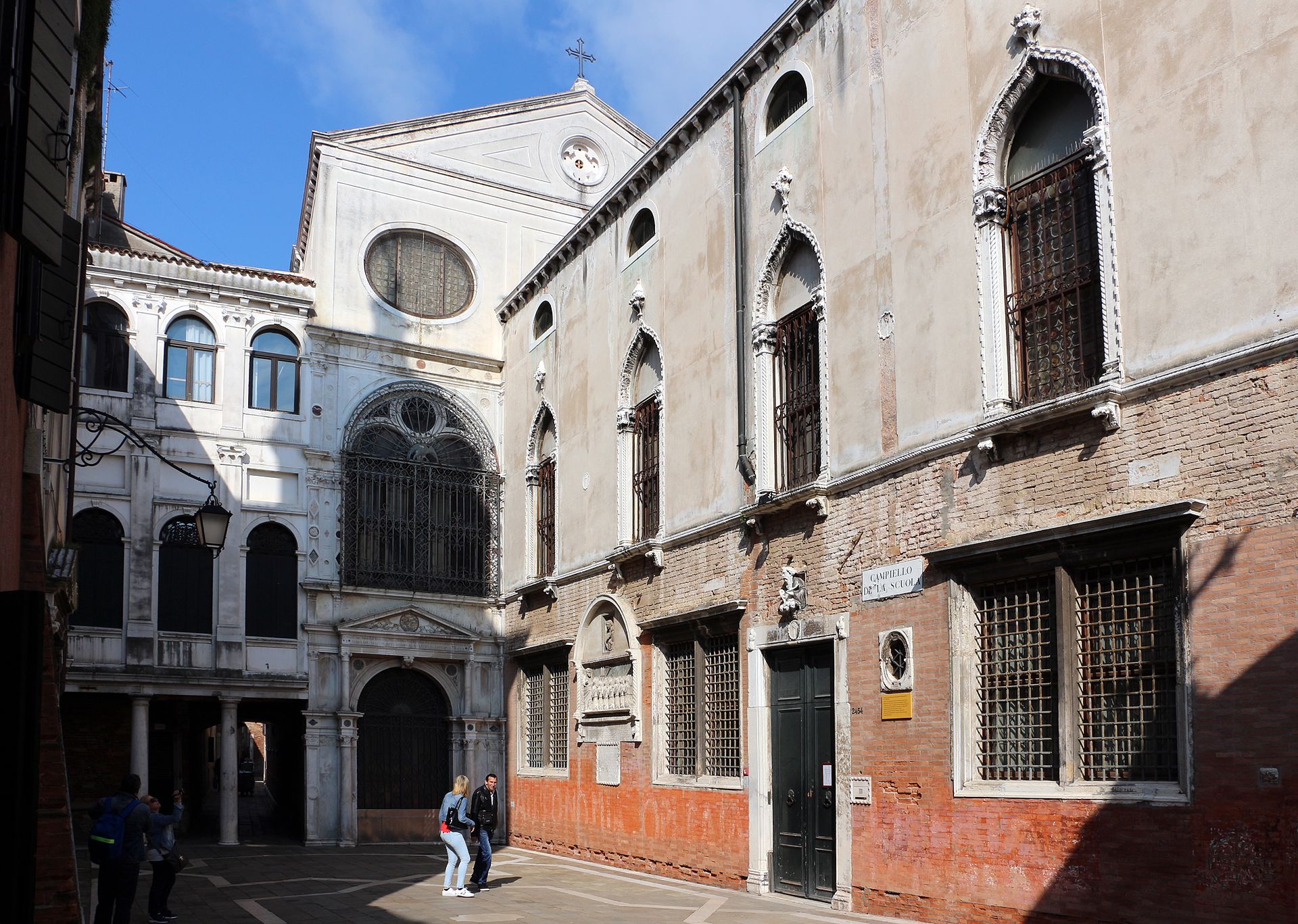
Great School of St. John the Evangelist
Europe,
Italy,
citta,
San Polo
The Scuola Grande of San Giovanni Evangelista, located in the district of San Polo in Venice, is one of the oldest and most prestigious institutions in the city. Founded in 1261, the Scuola is one of the six most important lay confraternities, the so-called “Scuole Grandi”, which played a crucial role in the social and religious life of Venice.
The Scuola was initially established at the church of Sant’Aponal, but in 1301 it moved to Contrada San Stin, renting some premises owned by the Badoer family. The construction of the current building began in 1369, when the Grand Chancellor of the Order of Cyprus and Jerusalem, Philippe de Mézières, donated a precious fragment of the True Cross to the Scuola, which became one of the most venerated relics in Venice. This event greatly increased the prestige and influence of the Scuola.The current building is a masterpiece of Venetian Gothic and Renaissance architecture. The Gothic facade, completed in 1454, and the monumental internal staircase designed by Mauro Codussi in 1498, are just some of the prominent architectural elements. The monumental staircase, with its elegant design and refined details, leads to the upper floor, where the main halls of the Scuola are located.One of the most fascinating rooms is the Chapter Hall, redesigned in the 18th century by the architect Giorgio Massari. The hall is characterized by a raised ceiling decorated with twelve large oval windows that illuminate the interior, and a floor of colored marbles designed by Massari himself. The altar, dedicated to Saint John the Evangelist, houses a statue of the saint created by the sculptor Giovanni Maria Morlaiter in 1732-1733. The walls of the room are adorned with paintings illustrating episodes from the life of Saint John the Evangelist, based on the “Golden Legend” by Jacopo da Varagine, while the ceiling features a cycle of frescoes with scenes from the “Book of Revelations”.Another focal point of the Scuola is the Oratory of the Cross, which houses the precious reliquary containing the fragment of the True Cross. The reliquary, made of rock crystal and gilded silver, is a Gothic work of extraordinary beauty. The oratory is decorated with 18th-century stuccoes and a central fresco depicting the “Triumph of the Cross” by Francesco Maggiotto.The Scuola is also known for the cycle of paintings on the Miracles of the True Cross, created between 1496 and 1501 by renowned artists such as Gentile Bellini, Vittore Carpaccio, and Giovanni Mansueti. These paintings, which once adorned the Oratory of the Cross, were transferred to the Gallerie dell’Accademia in Venice during the Napoleonic period, but remain among the most important masterpieces of Venetian Renaissance painting.The history of the Scuola is closely linked to the political and social events of Venice. During the Napoleonic period, the Scuole Grandi were suppressed and many of their properties were confiscated. The Scuola of San Giovanni Evangelista was closed in 1806 and many of the artworks were transferred to state ownership. Only in 1929 was the Scuola reopened and gradually restored, reclaiming its role as an important cultural and religious center.
Read More