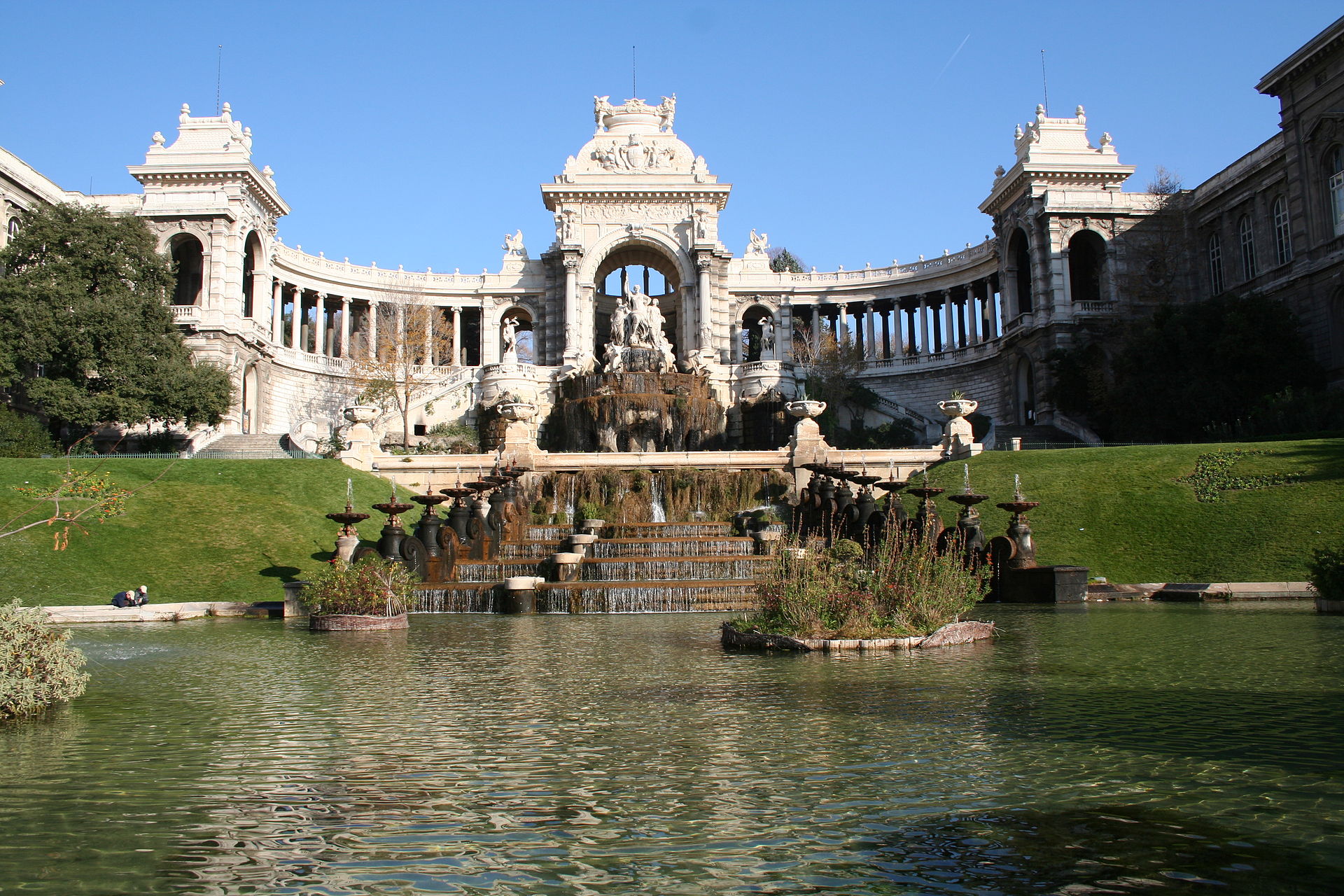
Longchamp Palace
Europe,
France,
Marseille,
Longchamp
The Palais Longchamp is one of the most iconic and evocative buildings in Marseille, a true symbol of the city that enchants with its architectural magnificence and rich cultural heritage. Built between 1862 and 1869 by architect Henri-Jacques Espérandieu, the palace was erected to celebrate the arrival of water from the Durance to Marseille through the Canal de Marseille, a fundamental engineering work that solved the city’s water supply problems.
The genesis of the Palais Longchamp is closely linked to the need to provide drinking water to a rapidly growing Marseille in terms of population and economy. The Canal de Marseille, completed in 1849 after 15 years of work, was one of the most imposing engineering works of its time, bringing water from the Durance river to the city. To celebrate this achievement, it was decided to build a monument that would testify to the importance of the work and serve as a symbol of progress and modernity.The Palais Longchamp is an extraordinary example of Second Empire architecture, characterized by an eclectic style that combines baroque and classical elements. The structure of the palace is dominated by a monumental fountain, the Fontaine de Longchamp, which represents an imposing allegory of the Durance river, with statues and sculptural groups symbolizing the fertility and abundance brought by water. At the center of the fountain stands the figure of a woman, representing the Durance, pouring water into a basin below, surrounded by mythological figures and animals.The palace itself is divided into two main wings, housing respectively the Museum of Fine Arts of Marseille and the Museum of Natural History. The Museum of Fine Arts, located in the left wing, is one of the oldest museums in the city, inaugurated in 1801, and houses a rich collection of works ranging from the 16th to the 19th century. Among the exhibited masterpieces are works by great masters such as Rubens, Courbet, and Puget, offering a journey through the history of European art. The Museum of Natural History, in the right wing, is renowned for its collections of zoology, paleontology, mineralogy, and botany, offering an educational and fascinating experience for visitors of all ages.The garden of the Palais Longchamp, the Jardin du Palais Longchamp, is a green oasis in the heart of the city, designed to be an ideal complement to the palace’s architecture. This landscaped park, with its lakes, waterfalls, and artificial caves, offers a space for relaxation and leisure for citizens and tourists, as well as an ideal place for walks and outdoor activities. The garden also houses a small zoo, which fascinates younger visitors.An interesting anecdote related to the Palais Longchamp concerns the inauguration ceremony of the fountain, which took place on August 15, 1869. During the event, an impressive amount of water was made to gush from the fountain, symbolizing the arrival of water from the Durance to Marseille. This event was celebrated with great enthusiasm by the citizens, who saw in the fountain a sign of prosperity and well-being for their city.
Read More