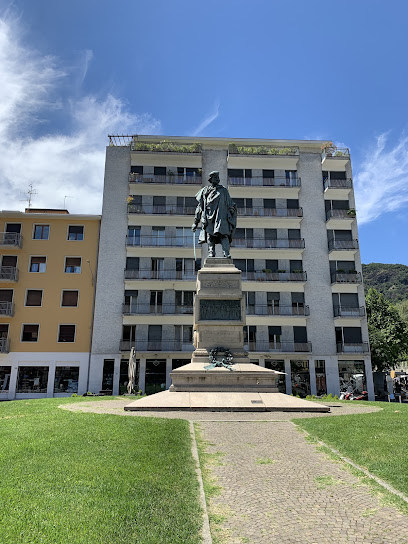
Monument to Giuseppe Garibaldi, Como
Europe,
Italy,
Como,
The Monument to Giuseppe Garibaldi, located in the heart of Como, is an important testimony to Italian patriotism and an iconic symbol of the city. Inaugurated in 1896, this monument pays homage to one of the most significant figures of the Italian Risorgimento, the movement that led to the unification of Italy in the 19th century. Garibaldi is known for his role as a military and political leader, and his presence in Como is particularly significant, as the city witnessed his passage during the campaigns for unification. This sculpture not only celebrates the memory of a national hero but also reflects the historical and cultural identity of a city that has seen crucial moments in Italian history. The history of the Monument to Giuseppe Garibaldi is intrinsically linked to the figure of Garibaldi himself. Following his death in 1882, there was a growing desire to pay tribute to the leader who had become a symbol of national unity. The project for the monument was entrusted to the sculptor Giovanni Battista Venturini and his assistant. The choice of location was not random: the monument was erected in Piazza Cavour, a central place that represents a bridge between the past and the future of Como. In 1891, thanks to a committee of citizens who wished to honor Garibaldi, fundraising for the construction was initiated. The inauguration ceremony took place on September 22, 1896, and was an event that involved the entire community and local authorities. During the ceremony, many paid tribute to the great leader, and public participation was massive, a sign of how Garibaldi was still alive in the hearts of Italians. The monument has undergone modifications and restorations over the years, with interventions in 1938 and 2006, to preserve its artistic integrity and ensure that the message of unity and freedom it represents continues to resonate. The sculpture is made of white marble, with particular attention to detail, and the base is made of granite, a structure that provides solidity and stability to the monument itself. Garibaldi in Como has a special significance also because he formed significant bonds with the local citizens here. The connection between Garibaldi and Como is also linked to the figure of the comasca woman, Anita Garibaldi, who supported the leader in many of his battles and represents a symbol of courage and patriotic love. As one approaches the Monument to Giuseppe Garibaldi, one cannot help but notice its impressiveness. The white marble sculpture depicts Garibaldi standing, with a face that expresses determination and nobility. The expression on his face has been sculpted with great skill, emphasizing his strength and charisma as a leader. To the left of Garibaldi’s statue, two allegorical figures can be seen, representing Liberty and Homeland. The latter are fundamental symbols of the Risorgimento and reflect the desire for independence and unity of Italians in the 19th century. The figures are carved with rich detail, from the drapery of the garments to the features of the faces, contributing to the depth of the monument’s meaning. Moving a bit further on, one can observe the inscriptions carved on the base, which recount the life and deeds of Garibaldi. The inscriptions not only honor his commitment to the struggle for Italian unity but also remember the cult of the figure of Garibaldi and his fundamental role in the history of our country. There are details of the battles he fought and key moments that marked his life. Another notable aspect is the choice of location: Piazza Cavour, a strategic and symbolic area of Como, which helps create a suggestive setting around the monument. From various viewpoints in the square, the monument stands majestically in the landscape, a constant reminder of the history experienced by the city. Next to the monument is a system of well-kept gardens, furnished with benches that invite reflection. These green spaces not only beautify the area but also create an ideal environment to understand and meditate on the meaning of liberty and unity that Garibaldi represented. Finally, upon closely observing the architectural details of the monument, one can notice neoclassical influences. The neoclassical style, characterized by sober forms and a certain monumentality, is reflected in the lines of the monument, giving great dignity and impressiveness to the entire work. The choice of this style is not random; it is linked to a period when there was an effort to evoke the ideal of the greatness of ancient Rome and its history. The Monument to Giuseppe Garibaldi is set in a historically and culturally significant context. The square in which it is located is surrounded by other historical buildings, including Palazzo Cavour, which was the site of important events in Como’s history. Just a short walk away, you can also discover the Teatro Sociale, another emblem of Como’s culture, where events and performances attract artists from all over the world. While walking in the area, don’t forget to visit the Cathedral of Como, the Gothic cathedral that has its roots in the Middle Ages. Its imposing façade and architectural details offer further food for thought on the history and evolution of this city and its link with the transformations in Italy. Another interesting place to consider is the Museo Giovio, which houses a collection of artworks and archaeological artifacts that tell the story not only of Como but also of its cultural influences over the centuries. Here, you can further delve into the connections between Garibaldi’s story and the events that characterized the Risorgimento. A curious aspect regarding the Garibaldi monument is the choice to use marble from the Apuan Alps in Tuscany, a precious material widely used in art and architecture. This choice symbolizes not only the artistic quality of the monument but also a connection to the Italian artistic tradition. Additionally, Giovanni Battista Venturini, the sculptor, is known for having created other monumental works in Italy, thereby contributing to the dissemination of the patriotic message through art. His mastery is appreciated, and the Garibaldi monument remains one of his most famous works. Another interesting detail is that the celebration of the monument should not be seen solely as a commemoration of the past, but also as a constant reminder of the values of freedom and unity that are still relevant in Italian society today.
Read More