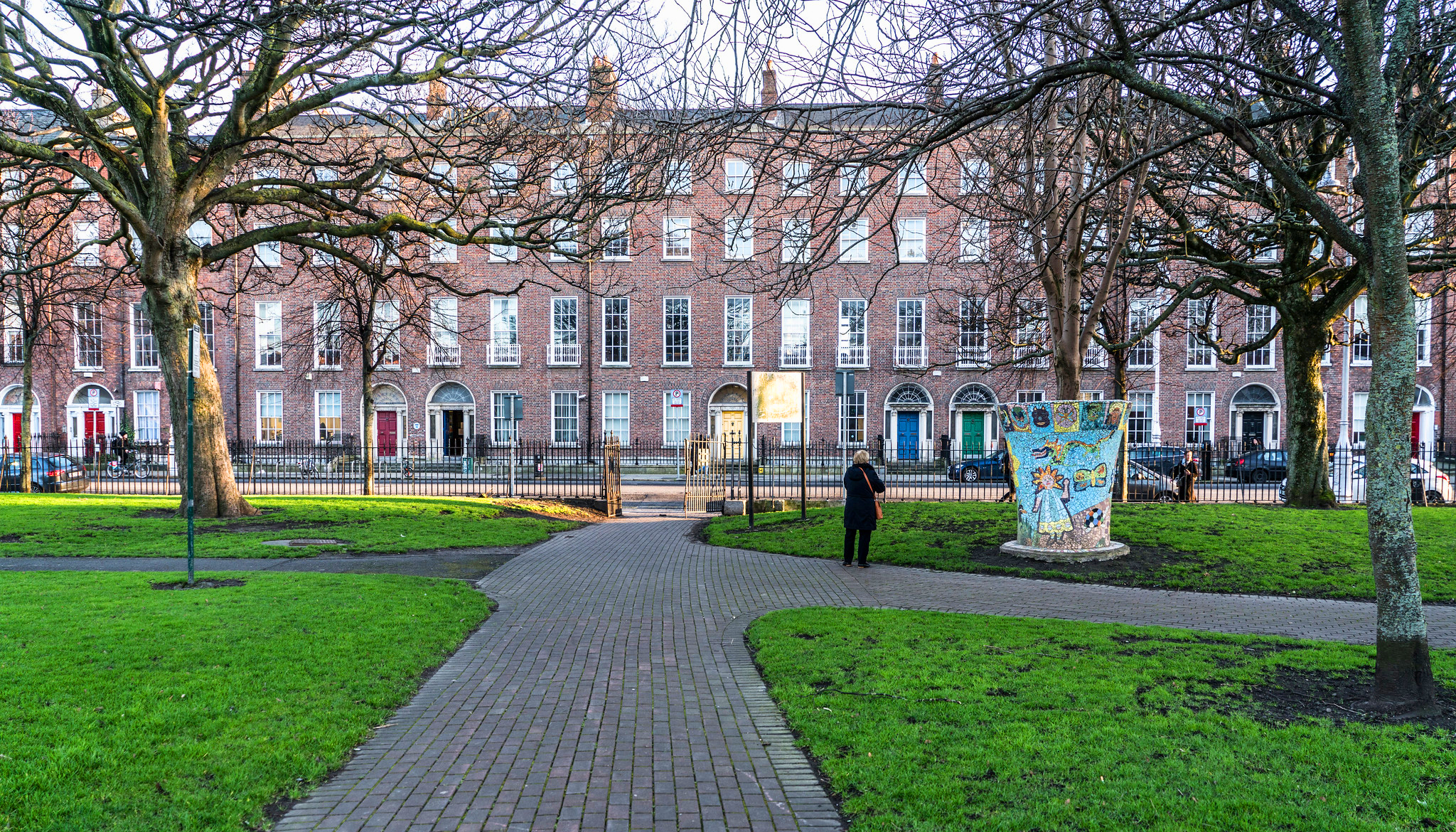
Mountjoy Square
Europe,
Ireland,
citta,
Dublin 1
Mountjoy Square, located in the northern part of Dublin’s city center, is one of the most charming and historically significant Georgian squares in the city. This square, unique in its perfect symmetry, is an emblematic example of Georgian architecture and a place rich in history, culture, and social changes.
The construction of Mountjoy Square began towards the end of the 18th century and was completed in the early 19th century. It was developed by Luke Gardiner, the first Viscount Mountjoy, as part of a broad urban planning project that included several areas of the city. The square was intended to represent a prestigious work, reflecting Gardiner’s ambition to create a high-level residential space for Dublin’s elite. The houses surrounding the square are characterized by red brick facades, elegant doors, and sophisticated architectural details, which together create an atmosphere of great elegance and refinement.During the 19th century, Mountjoy Square became one of the most desirable residences in the city, hosting numerous illustrious figures. Among the most famous residents were Arthur Guinness, founder of the renowned Guinness brewery, and the poet and nationalist leader John O’Leary, a friend of the famous poet W.B. Yeats, who often visited him at his house at number 53. Sean O’Casey, an Irish playwright and founding member of the Irish Citizen Army, also lived in the square during the Irish War of Independence.During the Easter Rising of 1916, Mountjoy Square was one of the places where the leaders of the rebellion, such as Patrick Pearse, secretly met to plan their actions. Later, in 1919, the Dáil Éireann, the revolutionary Irish parliament, met clandestinely in one of the houses on the square when the British authorities declared the organization illegal.The 20th century brought significant changes to Mountjoy Square. With urbanization and economic changes, many of the original Georgian residences fell into disrepair. In the 1960s and 1970s, a significant part of the square was demolished or left to decay, causing concern among historians and architects. However, thanks to the efforts of the Irish Georgian Society and other organizations, many of the Georgian facades have been reconstructed to maintain the historical integrity of the area.Today, Mountjoy Square has been revitalized thanks to urban renewal projects that have allowed the recovery of many buildings and the introduction of new functions. The park at the center of the square, originally reserved for residents, is now a public area offering sports facilities, play areas, and walking paths. The park also hosts cultural and social events that enliven the local community.One of the most fascinating features of Mountjoy Square is its rich artistic and architectural heritage. Art critic Christine Casey has praised the square for its refined neoclassical stuccoes, which she considers superior to those of other Georgian squares in Dublin. This architectural detail, along with the brightly painted Georgian doors and historic lampposts, gives the square a unique and historically rich atmosphere. An interesting anecdote concerns the period when the famous rock band U2 used an apartment in Mountjoy Square for rehearsals during their early years. This detail adds a modern touch to the rich history of the square, connecting the cultural past with the musical present.
Read More