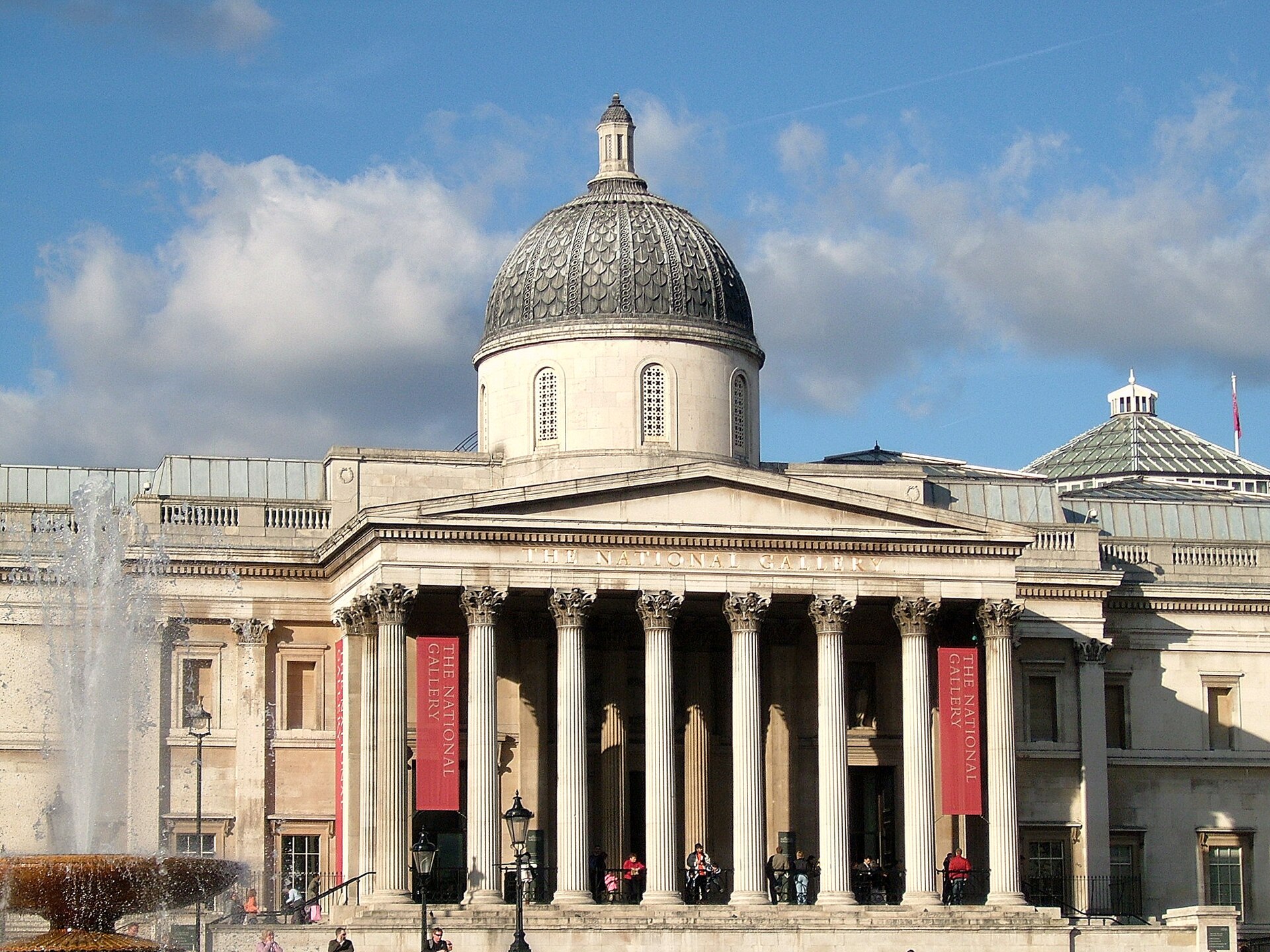
National Gallery
Europe,
United Kingdom,
citta,
Trafalgar Square
The National Gallery in London, located in Trafalgar Square, is one of the most prestigious art institutions in the world. Founded in 1824, its creation marked a revolutionary moment for public access to art. The initial collection, composed of 38 paintings purchased by the merchant John Julius Angerstein, was first exhibited in Angerstein’s residence on Pall Mall. This collection included masterpieces by artists such as Rubens, Raphael, and Rembrandt, and formed the nucleus around which the gallery would continue to grow.
In 1838, the National Gallery was moved to its current location, an imposing building designed by William Wilkins. Despite initial criticisms regarding its modest size, the building soon became a symbol of British commitment to making art accessible to the public. The gallery initially shared space with the Royal Academy of Arts, but soon gained its autonomy and began to expand to accommodate an ever-growing number of artworks.A crucial moment in the history of the National Gallery was the acquisition of Sir George Beaumont’s collection in 1826, followed by that of Reverend Holwell Carr in 1831. These acquisitions significantly increased the quality and quantity of the works on display, attracting an increasingly diverse and vast audience.During the mid-19th century, under the direction of Sir Charles Eastlake, the National Gallery greatly expanded its collection of Italian painting, acquiring works by Botticelli, Uccello, and Piero della Francesca. Eastlake traveled across Europe to personally select the paintings, ensuring that the gallery possessed some of the best works of the Renaissance.The collection was further enriched by numerous donations and bequests, such as that of J.M.W. Turner, who left over 1,000 paintings, drawings, and watercolors to the gallery. These works, initially exhibited in South Kensington, were later transferred to the main location in Trafalgar Square. In 1889, Henry Tate, a wealthy industrialist, donated his collection of British artworks and funded the construction of a new gallery, which would later become the Tate Gallery, thus separating British works from European ones.Today, the National Gallery houses over 2,300 paintings spanning from the 13th to the 20th century. Among the most famous masterpieces are Jan van Eyck’s “The Arnolfini Portrait,” Leonardo da Vinci’s “The Virgin of the Rocks,” Vincent van Gogh’s “Sunflowers,” and Paolo Uccello’s “The Battle of San Romano.” These works not only represent the pinnacle of European art, but also offer a glimpse into the different historical and cultural epochs that influenced the artists. One of the most fascinating anecdotes concerns Botticelli’s “Venus and Mars,” which was altered during the Victorian era to conform to the decorum norms of the time. It was only in the 1950s, during a restoration, that it was discovered that the original painting had been altered to cover details considered inappropriate.
Read More