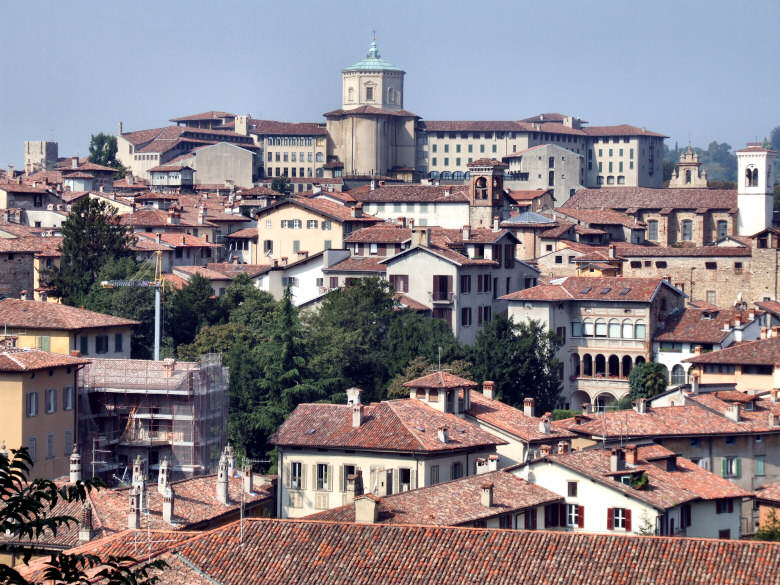
Palazzo Moroni - Bergamo
Europe,
Italy,
Bergamo,
Palazzo Moroni is a symbol of Bergamo’s identity, a building that reflects the wealth and prestige of Bergamo’s nobility in the 17th century. This historic residence, also known as Palazzo Moroni della Rocca, is characterized by elegant Baroque architecture and is located in the heart of the Città Alta. Built between 1575 and 1620 for the Moroni family, this palace is renowned not only for its architectural beauty but also for its important role in the cultural and political life of Bergamo. Over the centuries, it has undergone various transformations and restorations but has always maintained its historical and aristocratic essence.Origins and HistoryThe origins of Palazzo Moroni date back to the second half of the 16th century. The Moroni family, one of the most influential families in Bergamo, decided to build a residence that reflected their status and power. The design of the palace is generally attributed to the architect Giovanni Battista Baroni, who introduced elements typical of the late Renaissance, which later evolved into Baroque style.Construction of the palace began in 1575 but was not completed until 1620, the year when the interiors were also finished. The Moroni family amassed a vast artistic heritage, commissioning numerous works to embellish the internal spaces of the palace. This building soon became a true cultural center, hosting socially and politically significant events and gatherings.Throughout the 19th century, the palace underwent several changes. After the fall of the feudal regime and the proclamation of the Kingdom of Italy in 1861, the palace was adapted to the new needs of the institutions that began to occupy the spaces. Romantic influences and new functional uses partially altered its original appearance, yet it did not lose its historic character.Between 1921 and 1925, Palazzo Moroni was transferred to the Province of Bergamo. During the 20th century, the palace became home to the tourism office and later the Civic Library, which was destined to become an important cultural center for the city. In 1960, the palace was restored to enhance and recover its original features and was also reopened to the public.Today, Palazzo Moroni houses art collections, exhibition events, and cultural initiatives. Its history, enriched by a series of different ownerships and destinies, allows each visitor to perceive its importance across the ages.What to ObserveAs you approach Palazzo Moroni, you are struck by the main façade, which features characteristic elements of the Baroque style. Its structure is adorned with frescoes and stuccoes, particularly the entrance portal, embellished with delicate sculptures that reflect the nobility of the Moroni family. Let us begin to explore the architectural details of this splendid residence.Upon entering, the atrium is a clear example of Baroque style, with painted ceilings and rich decorations. On the walls, you can admire paintings that evoke mythological and historical scenes, reflecting the high-bourgeois culture of the time. We find ourselves in front of a grand staircase that leads to the upper floors, where the rooms are arranged around a spacious inner courtyard.Ascending to the first floor, we arrive at the Salone delle Feste, an extraordinary room adorned with frescoes by the local painter Andrea Previtali. The works, created between 1621 and 1625, celebrate classical mythology and spirituality, creating an atmosphere of pure epic. The decorative volutes and details make this hall one of the most fascinating places to visit.Continuing on our journey, one cannot help but notice the Studio of the Marquis, furnished with period furniture and artworks. Here, Bergamasque artists have left their mark, enriching the spaces with paintings and sculptures often themed around nature and everyday life. The overall atmosphere conveys the intimate life and culture of Bergamo’s nobility.In the Dining Room, we find a large table set with Baroque-style dishes. This space was reserved for banquets and official celebrations of the family. The art of the table and the artifacts used testify to the opulence of the banquets of the past. Every detail, from the porcelain to the candelabra, tells the story of aristocratic luxury.Finally, the view from the balconies of the palace is not to be missed. Moving toward the back side, one is rewarded with a splendid panorama of the Città Bassa and the surrounding landscapes. The strategic position of Palazzo Moroni allows visitors to appreciate not only the meeting between architecture and nature, but also Bergamo’s historical connection to its geography.Every element of Palazzo Moroni invites discovery, and visitors can feel part of the story that envelops this unique space.Context and ConnectionsPalazzo Moroni is located in the heart of Città Alta in Bergamo, an area rich in history and culture. This part of the city is famous for its medieval streets, historic churches, and lively squares, making it an ideal place to immerse oneself in Bergamasque tradition. Next to the palace, one can visit the Church of Santa Maria Maggiore, a magnificent example of Romanesque-Gothic architecture. This church is known for its frescoes and the mosaic on its façade, creating a perfect combination with the nobility of Palazzo Moroni.Another point of great interest nearby is the Donizetti Theatre, which celebrates the famous Bergamasque composer Gaetano Donizetti. Opened in 1791, this theater is a hub of the city’s cultural life and regularly hosts opera performances, concerts, and theatrical events. Between art and entertainment, Bergamo offers a vibrant and stimulating context.Lastly, not far from Palazzo Moroni, lies the Museum of Natural Sciences, which offers an interesting exploration of biodiversity and the sciences. Here, one can discover the evolution of life on Earth through a variety of interactive exhibits and scientific collections.CuriositiesDid you know that Palazzo Moroni was originally surrounded by a large garden that extended up to the city’s walls? This green space was used to host events and celebrations, but over time it was gradually reduced. Today, there are no evident traces of this ancient garden, but it is interesting to think about how it must have appeared.Additionally, Palazzo Moroni has witnessed significant historical events, including the battle of Bergamo during the Italian wars of independence. This important past has left an indelible mark on the cultural identity of the city.Finally, during the 19th century, Palazzo Moroni became renowned for hosting meetings of intellectuals and artists. This made it not only a place of residence but also a center for cultural and artistic exchange.
Read More