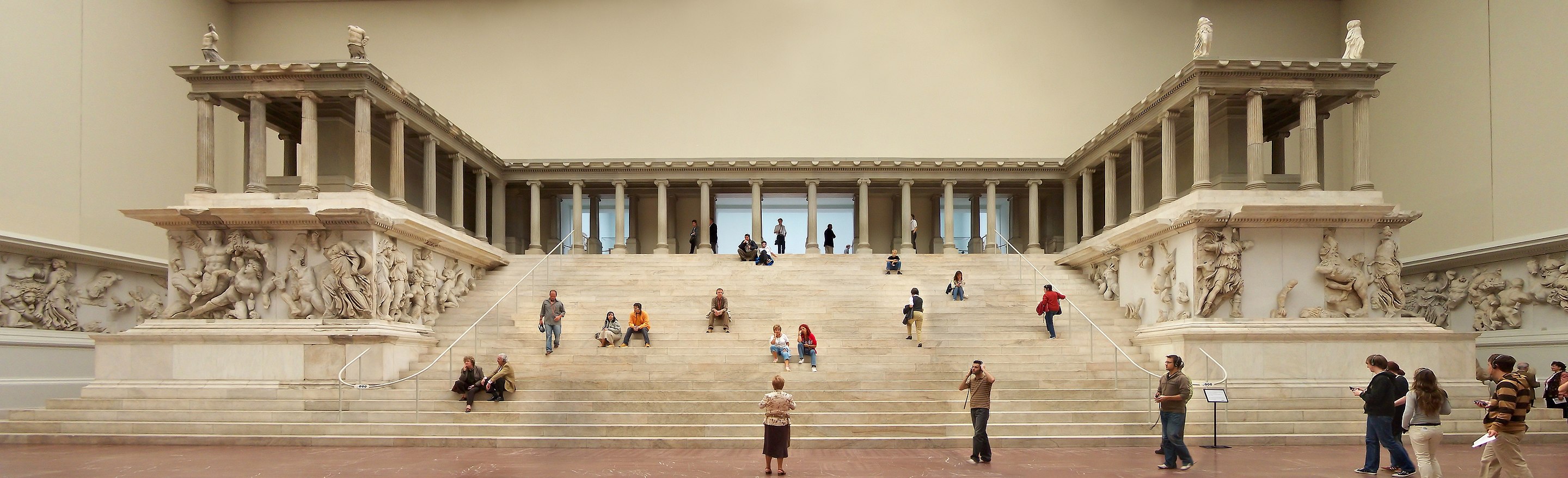
Pergamon Museum
Europe,
Germany,
citta,
Mitte
The Pergamon Museum in Berlin, located on Museum Island, is one of the most famous and visited museums in the world. Inaugurated in 1930, this extraordinary complex houses three main collections: the Antikensammlung (Collection of Antiquities), the Near East Museum, and the Museum of Islamic Art. Each section offers visitors a fascinating journey through ancient civilizations, with works of immeasurable importance that reflect the grandeur and complexity of past cultures.
The highlight of the Pergamon Museum is undoubtedly the Pergamon Altar, one of the most imposing and significant works of ancient Greece. Dating back to the 2nd century BC, the altar was discovered during excavations conducted by the German archaeologist Carl Humann in Pergamon, in present-day Turkey, at the end of the 19th century. Transported to Berlin, the altar was reconstructed inside the museum and now occupies an entire room, with its impressive reliefs depicting the Gigantomachy, the mythological battle between gods and giants. This artistic representation not only amazes with its size and beauty, but also offers a unique window into the culture and religion of ancient Greece.Next to the Pergamon Altar, the museum houses other monumental works that capture the imagination of visitors. The Market Gate of Miletus, for example, is a grand marble entrance from the ancient Ionian city of Miletus, dating back to the 2nd century AD. This structure, with its Corinthian columns and finely carved architectural details, testifies to Roman influence on the architecture of Greek cities.Another must-see attraction is the Ishtar Gate, part of the walls of Babylon built under the reign of Nebuchadnezzar II in the 6th century BC. The gate, with its vibrant blue glazed bricks and depictions of sacred animals like dragons and bulls, is one of the most splendid examples of Babylonian art. This section of the museum offers an in-depth view of the greatness and religious symbolism of ancient Mesopotamia.The Near East Museum is equally fascinating, with a collection ranging from the early civilizations of Mesopotamia to the Sasanian era. Among the most important artifacts is the Code of Hammurabi, one of the oldest known collections of laws, inscribed on a basalt stele. This legal document, dating back to the 18th century BC, represents a fundamental example of the development of laws and justice in ancient Babylon.The section dedicated to Islamic art at the Pergamon Museum is also rich in treasures. The most famous is undoubtedly the Mshatta Facade, a part of the Umayyad palace of Qasr Mshatta, located in Jordan, dating back to the 8th century. The facade, with its intricate geometric and floral motifs, represents Islamic art at its peak and offers an exceptional example of the craftsmanship of artisans from that period.
Read More