Place de la Bastille
Europe,
France,
citta,
XI arrondissement
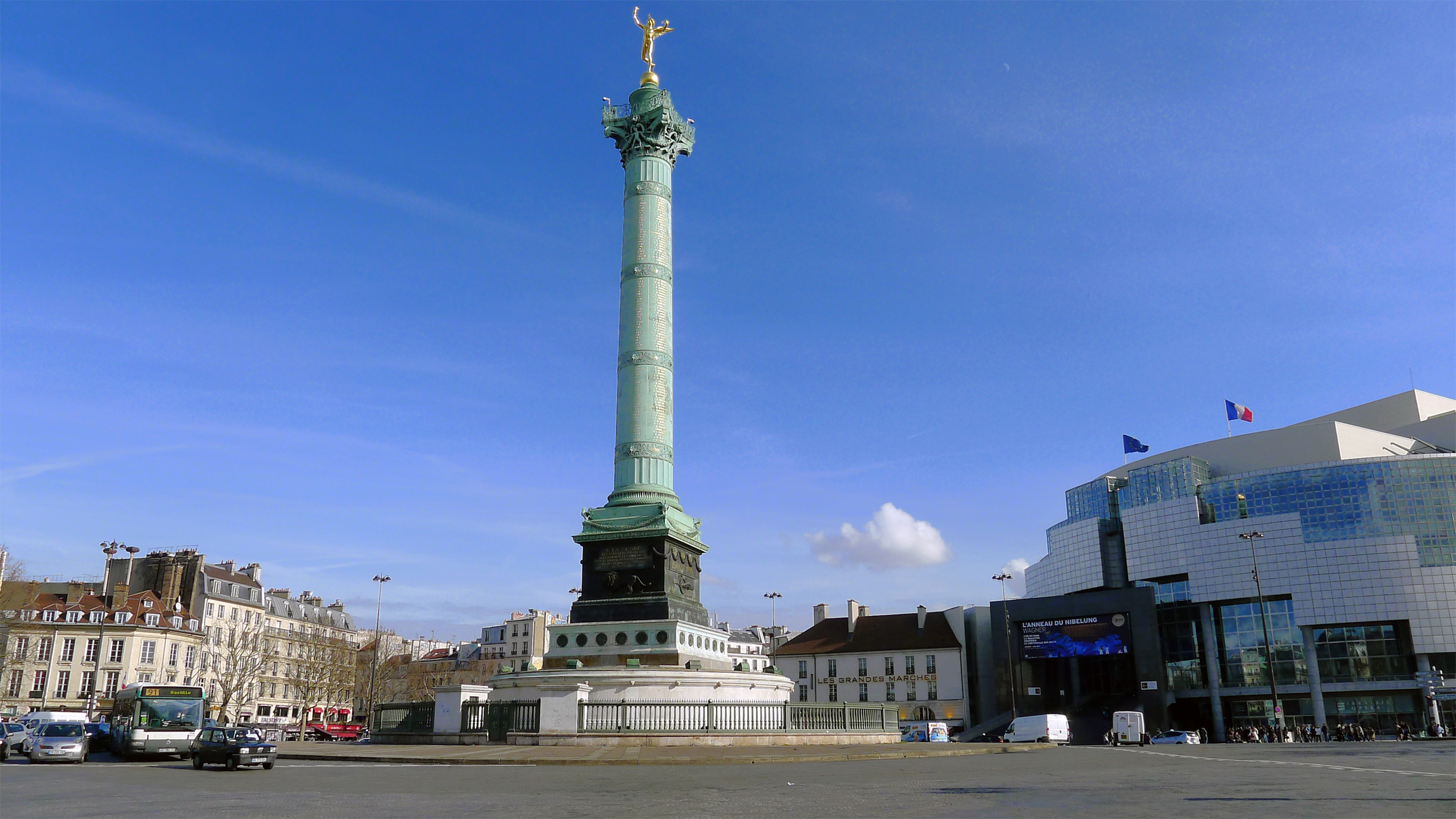
Place de la Bastille is one of the most emblematic and historically significant places in Paris, located at the intersection of three arrondissements: the eleventh, the twelfth, and the fourth. This space has been the scene of some of the most crucial events in French history, especially for its indissoluble link with the French Revolution.
The history of Place de la Bastille begins with its namesake, the Bastille, a fortress built in the 14th century to protect the eastern gates of Paris. Over time, the Bastille was transformed into a state prison used by the French monarchs to imprison political enemies, often without trial. This arbitrary use of power made the Bastille a symbol of royal oppression and a primary target for revolutionaries.On July 14, 1789, the storming of the Bastille marked the beginning of the French Revolution. Thousands of Parisians stormed the fortress, freeing the few remaining prisoners and seizing weapons and ammunition. This event not only marked the fall of the Bastille, but also the beginning of a period of radical political and social changes in France. Today, July 14 is celebrated as French National Day, commemorating the historical importance of that day.After the Revolution, the Bastille was completely demolished and its remains were sold as souvenirs or used for the construction of the Pont de la Concorde. In place of the fortress, a square was created which in 1792 was named Place de la Bastille. Today, the only visible sign of the fortress is a line of stones embedded in the pavement that traces the perimeter of the original Bastille.At the center of the square stands the Colonne de Juillet, an imposing 52-meter column erected to commemorate the July Revolution of 1830, which led to the fall of Charles X and the rise of Louis Philippe. The column is topped by the “Genius of Liberty,” a golden statue representing a winged spirit holding a torch in one hand and breaking chains in the other, symbolizing the freedom achieved.Place de la Bastille is also a place of great cultural and social relevance. In 1989, on the bicentenary of the French Revolution, the Opéra Bastille was inaugurated, a modern opera house that immediately became a reference point for Parisian cultural life. Designed by the Canadian-Uruguayan architect Carlos Ott, the Opéra Bastille combines contemporary architecture with extraordinary acoustics and scenic capacity, offering a platform for world-renowned opera productions.An interesting anecdote concerns the Elephant of Bastille, an ambitious Napoleonic project that envisioned the construction of a gigantic elephant-shaped fountain in the center of the square. Although the project was never completed, a plaster model of the elephant was erected in 1814 and remained in the square for many years, becoming a curious attraction until its demolition in 1846.From an urban planning perspective, Place de la Bastille is also an important transport hub. The Bastille metro station serves several lines connecting the square to other parts of the city, making it easily accessible and connected to many of Paris’s main points of interest.
Read More