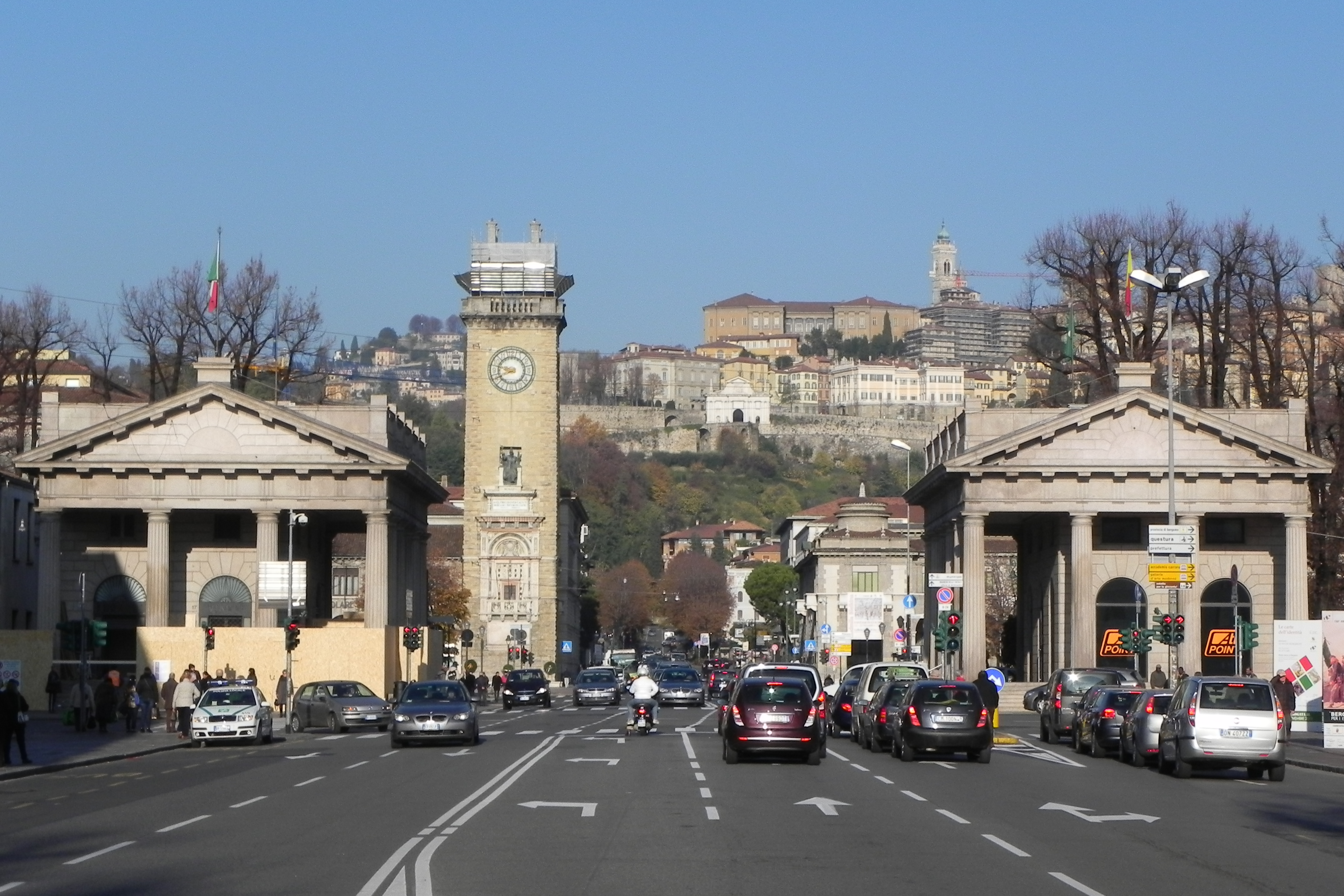
Porta Nuova Gate - Bergamo
Europe,
Italy,
Bergamo,
Porta Nuova, one of the most representative symbols of the city of Bergamo. This fascinating gate is located along the circle of the Venetian walls, a UNESCO World Heritage Site since 2017. Porta Nuova is an imposing testimony to Bergamo’s history and is known for its strategic and defensive role, as evidenced by the presence of architecturally rich elements. Built at the end of the 17th century, the gate is one of the main accesses to Città Alta, the vibrant heart of Bergamo, a place where history and culture intertwine uniquely.Origins and HistoryThe origins of Porta Nuova are linked to the need to strengthen Bergamo’s defensive system. The city, situated in a strategically geographical position, had always been the subject of disputes among various dominions. In 1561, the Venetian government decided to construct a new system of walls to enhance the city’s defense. The project was entrusted to architect Giovanni Paolo Lazzarini, who took care of the realization of the walls and gates.The construction of Porta Nuova began in 1680 and was completed in 1714. Despite its seemingly new architectural style, the gate reflects a legacy of styles and construction techniques from different periods. Porta Nuova features an imposing façade, characterized by the use of large stone blocks and architectural details that evoke Baroque art, a period of great cultural flourishing in Italy.Over the years, Porta Nuova has undergone various transformations and restorations. An important restoration took place in the 19th century, during which significant structural changes were made to strengthen the construction’s stability. These interventions helped preserve the beauty and grandeur of the gate, ensuring it remained an essential landmark in the architectural landscape of Bergamo.In the 20th century, the gate experienced renewed interest, especially with the enhancement of the Venetian walls. These monuments became the subject of research and studies, highlighting the historical importance and architectural value of Porta Nuova in the context of the city and its historic defenses. Today, the gate attracts numerous visitors and is a daily passageway for the city’s inhabitants, also serving as a starting point to explore Città Alta.What to ObserveAs we approach Porta Nuova, the imposing structure immediately strikes us. The façade, made of limestone, rises majestically, with two distinctive towers overlooking the city. The towers are not merely decorative elements but also served for surveillance and defense of the small square in front.After crossing the arch of Porta Nuova, we find ourselves in a large internal courtyard. To the left, there is a fresco depicting the Madonna della Misericordia, a work dating back to the original decoration of the gate. This fresco is a clear example of the importance of religion in the historical context of the city, reflecting the devotion of the people of Bergamo.Moving further in, to our right, we notice the large main portal, adorned with Baroque decorative motifs and a coat of arms representing the Republic of Venice. This coat of arms emphasizes Bergamo’s Venetian past and the importance of local institutions during the Venetian domination.A fundamental element not to miss is the surrounding wall, which runs along the perimeter of the gate. Here, we can observe some loopholes, narrow openings used by soldiers to defend the entrance. These loopholes clearly testify to the defensive role Porta Nuova played in the 17th and 18th centuries.As we ascend towards Città Alta, we encounter the bastions designed to provide a panoramic view of the lower city. From this observation point, we can gaze over the roofs and squares of Bergamo, appreciating how the Venetian walls harmoniously integrate into the urban landscape.Architectural DetailsDuring our visit, it is interesting to take note of the architectural details that adorn the gate. We see elegant stone frames surrounding the openings, decorative elements that highlight the artistic skill of the artisans of the time. Some of these details feature floral and geometric motifs typical of the Baroque style, which are as complex as they are fascinating.Another peculiar aspect of Porta Nuova is its use of local materials, reflecting the Bergamasque building tradition. The stone, sourced from nearby quarries, has been worked with remarkable precision, making the gate not only functional but also a work of art.Finally, looking outward, we notice the lighting that enhances the gate, especially at sunset, when the warm light brings out the beauty of the architectural details. If possible, take a moment to observe how the appearance of Porta Nuova changes with natural light.Context and ConnectionsPorta Nuova is situated in a highly valuable urban context, surrounded by some of the most significant historical sites in Bergamo. Proceeding beyond the gate towards Città Alta, we can easily reach Piazza Vecchia, the heart of the historic center, with its unmatched beauty and historic buildings. This place is an example of how art and social life intertwine, giving visitors a unique experience.Another point of interest nearby is the Basilica of Santa Maria Maggiore, located just a short walk away. This basilica is one of the masterpieces of Romanesque and Baroque architecture, with a richly decorated interior that deserves a thorough visit.Lastly, let us not forget the Palazzo della Ragione, also situated in Città Alta. This historic building symbolizes civic authority and public life in Bergamo, hosting various exhibitions and cultural activities throughout the year.CuriositiesAn interesting curiosity about Porta Nuova is that during its construction in the 18th century, an advanced engineering technique for the era was used, including the use of full arches, a distinctive element of military architecture of that period.Moreover, many of the stones used in the construction come from ancient Bergamasque quarries, which not only characterize the appearance of the gate but also tell the geological history of the region. The choice of materials is a clear reflection of the attention to the territory and local resources.Another curiosity to note is that after the fall of the Republic of Venice in 1797, the gate lost its status as a privileged access point to the city but remained an important identity marker of the Bergamasque community.Finally, Porta Nuova has been chosen as the backdrop for numerous cultural events, from celebrations of traditional festivals to concerts featuring local and international artists, thus confirming its vital role in the social fabric of the city.
Read More