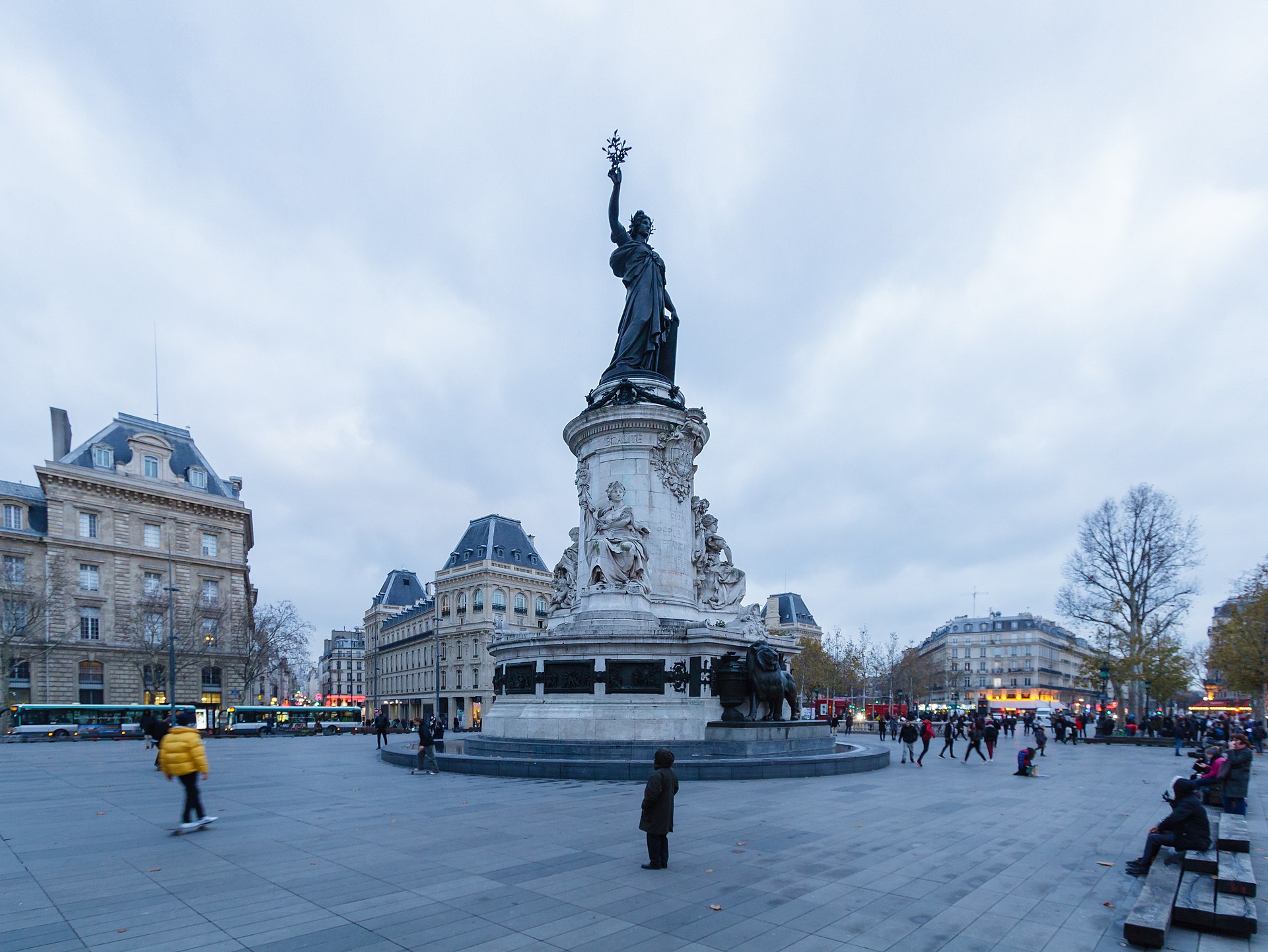
Republic Square
Europe,
France,
citta,
XI arrondissement
Place de la République, located in the heart of Paris, is one of the largest and most symbolic squares in the French capital. With its vast area of over three hectares, this square is an important crossroads of streets and boulevards, connecting different neighborhoods of the city and serving as a meeting point for Parisians and visitors. But beyond its practical function, Place de la République is also a place full of history, memory, and political and social meanings.
The square is named after the French Third Republic, proclaimed in 1870 after the fall of the Second Empire. The choice of the name reflects the importance of the Republic as a symbol of democracy and freedom, values that are at the center of modern French history. The heart of the square is dominated by a monumental statue of Marianne, the allegory of the Republic, erected in 1883. This statue, over 9 meters high and placed on a pedestal adorned with reliefs depicting key moments in republican history, is the work of sculptors Léopold Morice and Charles Morice. Marianne, with her proud posture and raised arm, symbolizes the values of liberty, equality, and fraternity.Place de la République has been the scene of numerous historically and politically significant events. During the Paris Commune in 1871, the square was one of the key locations of clashes between the Communards and government forces. Subsequently, the square became a symbol of resistance against oppression and the struggle for civil rights. In the following decades, Place de la République continued to be a venue for demonstrations, processions, and gatherings, reflecting the dynamism and civic engagement of Parisian citizens.Throughout the 20th and 21st centuries, Place de la République has undergone several urban transformations. In the 1970s, the square underwent a restructuring that included the expansion of surrounding streets and the creation of pedestrian spaces. However, it was the recent redevelopment completed in 2013 that radically transformed the square, making it more accessible and welcoming for pedestrians and cyclists. The project, designed by architect Alexandre Chemetoff, reduced the presence of cars and created a large central space dedicated to public events and recreational activities. The new Place de la République is now a place for socializing and gathering, with benches, trees, fountains, and wide pedestrian areas.From a social and cultural perspective, Place de la République is a microcosm of Parisian diversity. The square is surrounded by cafes, restaurants, and shops that reflect the variety of cultures present in the city. Nearby are theaters, cinemas, and cultural centers that contribute to making the area one of the liveliest and most dynamic in Paris. Additionally, the square is often used for cultural events, concerts, outdoor exhibitions, and temporary markets, attracting a diverse audience and animating the neighborhood’s life.A significant anecdote related to Place de la République concerns the historic demonstration in 2015, following the terrorist attacks against the satirical newspaper Charlie Hebdo and a kosher supermarket. Thousands of people gathered in the square to express their solidarity with the victims and to defend freedom of expression and republican values. This event strengthened the square’s role as a symbol of resistance and national unity in times of crisis.In addition to its political significance, Place de la République is also a place of memory. Numerous monuments and commemorative plaques recall historical events and important figures in French history. The statue of Marianne itself is surrounded by other sculptures representing Liberty, Equality, and Fraternity, the three fundamental principles of the French Republic. These elements make the square not only a thoroughfare but also a space for reflection and remembrance.
Read More