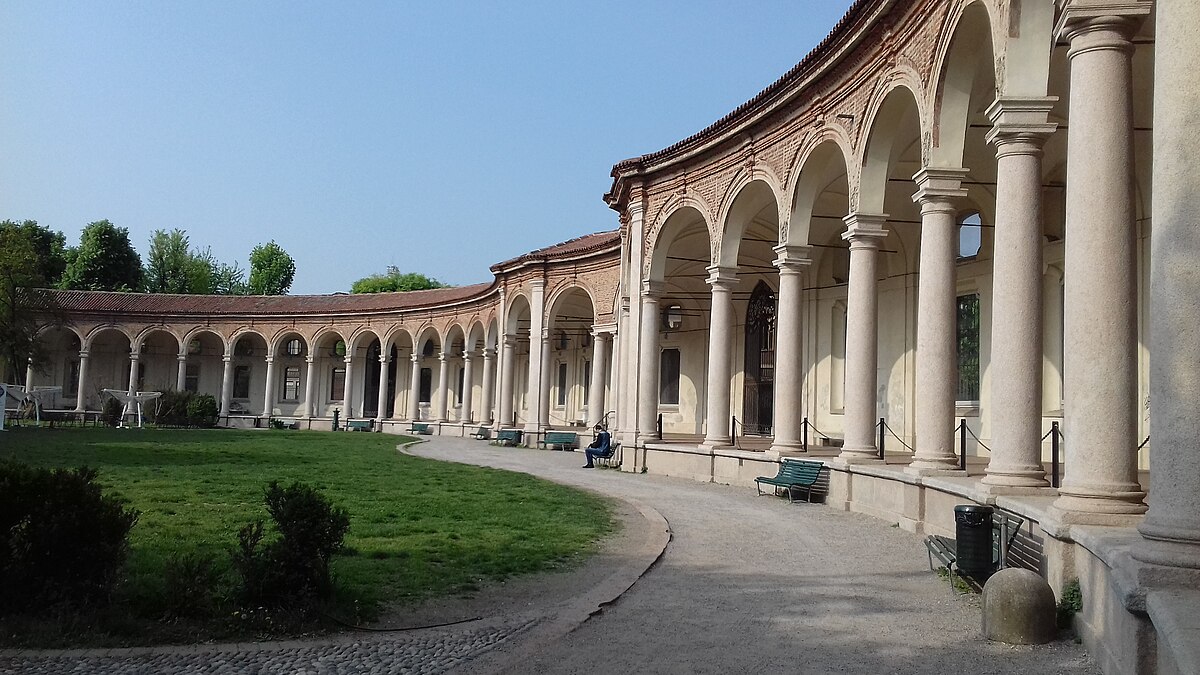
Roundabout of Besana
Europe,
Italy,
citta,
Porta Vittoria
The Rotonda della Besana, one of the most suggestive examples of Milanese Baroque, is an architectural complex located in the heart of Milan. Originally known as Foppone dell’Ospedale Maggiore, it was conceived as a cemetery for the Ospedale Maggiore of Milan in the late 17th century. Construction began in 1695 under the direction of engineer Arrigoni and was completed in 1731 with the contribution of architect Francesco Croce. This site, initially used to bury the dead of the hospital, is distinguished by its large circular portico surrounding the church of San Michele ai Nuovi Sepolcri.
The complex, with its elegant arches and sinuous lines, is an example of Lombard Baroque, an architectural style that blends the opulence of the Baroque with a certain classical sobriety. The church of San Michele, located in the center of the portico, has a Greek cross plan, unusual for the Milanese context of the time, with an octagonal dome rising in the center. The interior decorations, although sober compared to Baroque standards, include fluted stone pillars and Ionic capitals decorated with skulls and bones, reflecting the original cemetery function of the place.
During the 18th century, the Rotonda became an important burial place for the citizens of Milan, hosting almost one hundred and fifty thousand bodies. However, with the Austrian health legislation of 1792 banning cemeteries within city walls, the site was discontinued as a cemetery and began to decline. In the 19th century, during the Napoleonic rule, it was planned to transform the Rotonda into a pantheon of the Italian Kingdom, but with the return of the Austrians, the project was abandoned. Subsequently, the complex was used as a barracks, barn, and even a laundry for the hospital, until it fell into a state of abandonment.
The redevelopment of the Rotonda began in the 20th century. In 1958, the Municipality of Milan purchased the building, undertaking a restoration that transformed it into a public green and cultural space. The garden, over 7000 square meters, is now an oasis of tranquility in the city center, used for temporary exhibitions, screenings, and cultural events. The restoration of 2010-2012 brought to light the historical plasterwork and fragments of frescoes, further enhancing the complex.
An interesting anecdote concerns the emptying of the burial chambers in 1906, when about one hundred thousand bodies were found, many of which were mummified or saponified. This event sparked great scientific and hygienic interest, with studies conducted on many of the remains found. Dr. Cesare Staurenghi, a professor of topographic anatomy, collected numerous skulls for anthropological studies, many of which were later donated to the Museum of Natural History in Milan.
Today, the Rotonda della Besana is also home to the Children’s Museum of Milan, a place where children can explore and learn through interactive and educational activities. This contemporary use of the site as an educational and cultural center is a beautiful example of how historic spaces can be redeveloped to serve the modern community, keeping alive the memory of their past.
Architecturally, the Rotonda della Besana stands out for its undulating portico that creates a series of suggestive views. The exterior facade, in exposed brick, is interrupted by large windows and oculi that add lightness to the massive structure. Inside, the sail vaults cover the open arches towards the church, creating an effect of continuity and spatial fluidity that is typical of the Baroque style.
Read More