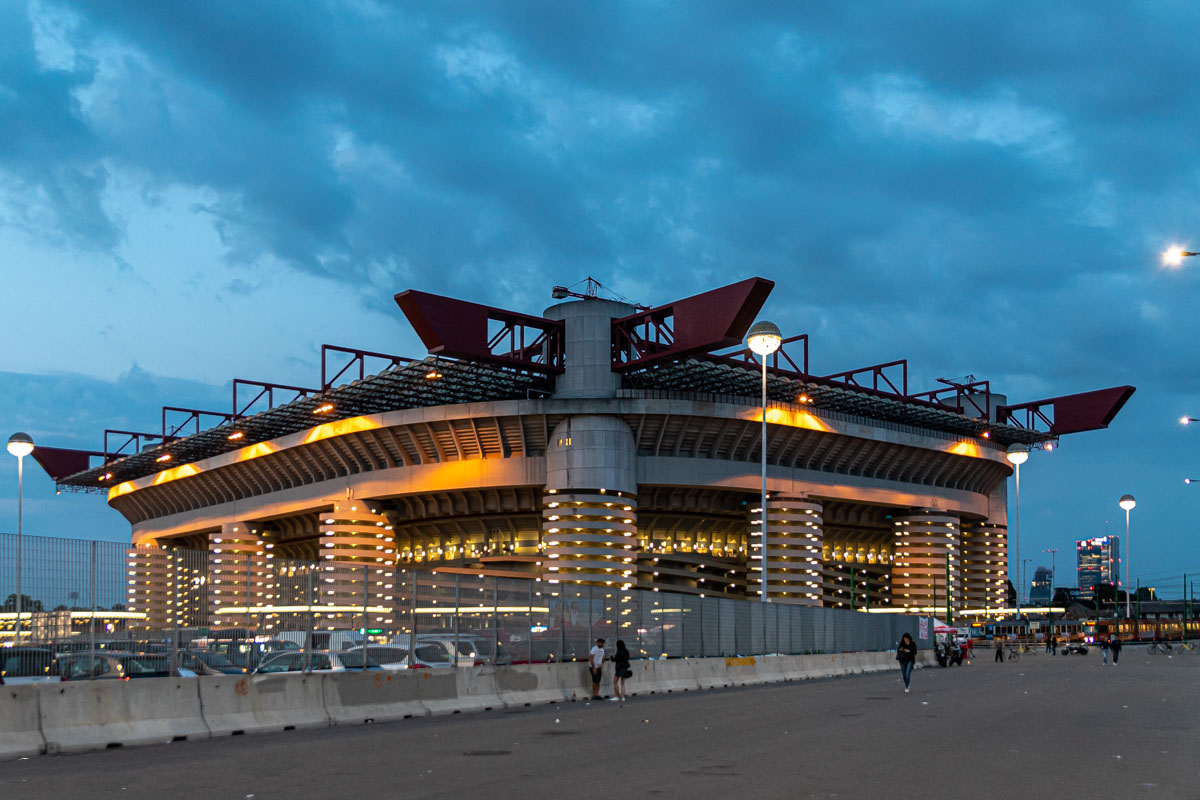
San Siro Stadium
Europe,
Italy,
citta,
San Siro
The Giuseppe Meazza Stadium, also known as San Siro, is one of the temples of world football and the beating heart of Milanese sports. Located in the San Siro district, the stadium is an undisputed symbol for football fans and one of the architectural icons of Milan. Its history began in 1925, when the president of Milan, Piero Pirelli, decided to build a new stadium dedicated exclusively to football, at a time when multifunctional stadiums were the norm.
Inaugurated on September 19, 1926 with a derby between Milan and Inter, the original stadium had a capacity of 35,000 spectators. Over the years, San Siro has undergone several renovations and expansions. The first major intervention took place in 1935, with the introduction of curves behind the goals, increasing the capacity to 55,000 seats. However, it was in 1955 that the stadium underwent a radical transformation, with the addition of a second tier that brought the capacity to over 80,000 spectators.The current structure of the stadium is the result of the renovation for the 1990 World Cup. This impressive restyling work, designed by architects Ragazzi and Hoffer, saw the addition of a third tier and the construction of 11 cylindrical towers supporting the roof. These interventions not only made San Siro one of the largest stadiums in Europe, with a capacity of around 80,000 seats, but also modernized its facilities, making it suitable for international standards.In addition to football matches, San Siro has hosted some of the greatest concerts in music history, from Bob Marley to the Rolling Stones, from Bruce Springsteen to Beyoncé. Its ability to transform from a football temple to a stage for musical events makes it a cultural and social reference point in Milan.A distinctive feature of San Siro is its ability to host two of the most important Italian football teams: AC Milan and Inter. This dual use has created a unique and vibrant atmosphere, especially during derbies, when the stadium becomes a true theater of passion and rivalry. Fans of both teams fill the stands with spectacular choreographies, making every match an unforgettable event.The official name of Stadio Giuseppe Meazza, adopted in 1980, pays tribute to one of the greatest Italian footballers, who played for both Milan teams. Meazza, known for his talent and elegance on the field, marked an era in Italian football, contributing to defining the prestige of the stadium that now bears his name.The stadium also houses the San Siro Museum, inaugurated in 1996, which offers a complete overview of the history of Milan and Inter, with a rich collection of trophies, historic jerseys, photographs, and memorabilia. This exhibition space allows visitors to immerse themselves in the history of Milanese football and relive the most exciting moments of the two teams.From an architectural point of view, San Siro represents an extraordinary example of how functionality can meet aesthetics. The cylindrical towers and futuristic roof have become a recognizable symbol not only for fans, but for anyone who appreciates sports architecture. The structure was designed to ensure optimal visibility from every section, perfect acoustics for concerts, and an engaging overall experience for all visitors.In recent years, there has been much discussion about the future of San Siro. Plans to build a new stadium shared by Milan and Inter have sparked heated debate between those who see the need for modernization and those who are attached to the tradition and history of San Siro. Whatever the outcome, the Giuseppe Meazza Stadium will remain forever a symbol of Milan, a place where history, sports, and culture intertwine in a unique and fascinating story.
Read More