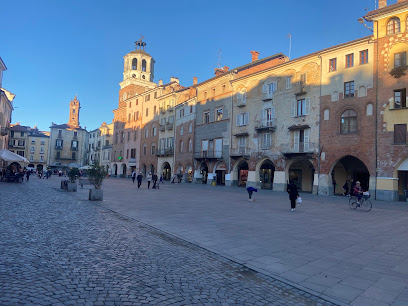
Savigliano Street – Cuneo
Europe,
Italy,
Cuneo,
Welcome to Contrada Savigliano, a fascinating corner of Cuneo, a city that shines for its history and culture. This neighborhood, with its quiet streets and historic architecture, represents a precious piece of the identity of this place. Cuneo, founded in 1198, has seen a vibrant and resilient community grow over the centuries, known for its strategic location between the Alps and the plain. Contrada Savigliano, in particular, is known for its artisanal traditions and the beauty of its historic buildings, testifying to a rich and varied past. Contrada Savigliano has ancient origins, dating back to the Middle Ages, a period when Cuneo was establishing itself as a nerve center for trade and defense. What we see today is the result of many centuries of transformations and adaptations. During the 13th century, the neighborhood began to develop as a true residential area, characterized by noble houses and artisan workshops. By the 15th century, Cuneo had become an important commercial center due to its position along the trade route between Italy and France. The name “Savigliano” likely derives from the nearby town of Savigliano, famous for being a center of production and exchange of goods. During the Renaissance, with the arrival of the Savoy dynasty, the neighborhood began to undergo significant urban transformations. In fact, the Savoy, who ruled Piedmont from the 13th century until the 19th century, invested considerable resources in the expansion and renewal of Piedmontese cities, including Cuneo. Many of the historic houses that we can admire today date back to this period, characterized by architectural styles ranging from Gothic to Baroque. Over the centuries, the neighborhood has adapted to socio-economic changes, undergoing renovations and restorations, while always maintaining a strong historical imprint. An important intervention occurred in the 19th century when Cuneo modernized and the ancient walls surrounding the city were largely demolished, making way for new infrastructures. The contemporary era has seen a renewed interest in the neighborhood, which has been the subject of revitalization efforts to preserve its historical heritage, enhancing local craftsmanship and creating spaces for cultural and social activities. In the heart of Contrada Savigliano, there are various elements to discover that tell the story and daily life of Cuneo. We begin with the facade of the Palazzo dei Banchi, located at the start of the neighborhood. This building, characterized by a simple yet elegant brick structure, was once home to banks and credit institutions. Its architectural sobriety reflects a period of transition toward more modern styles. Continuing on your left, we notice the Ancient Church of San Francesco, dating back to the 14th century. This place of worship is a testament to Gothic architecture, with its colorful stained glass windows depicting sacred stories. Inside, one can admire precious frescoes, the result of the work of local artists who contributed to bringing life and color to this spiritual space. As you make your way towards the heart of the neighborhood, you will find the Town Hall, a building representing the civic power of the city. Built in the 18th century, the palace is an important example of Baroque style, with rich and ornate architectural details that testify to Cuneo’s desire to assert its importance in the Piedmontese context. The main entrance is particularly striking, featuring a grand staircase leading to the spaces where municipal activities take place. Now let’s move towards Piazza Galimberti, located at the exit of the neighborhood. This square serves as a meeting point for residents and visitors, filled with cafes and eateries where one can enjoy a good coffee or a local sweet. The square is dominated by the Monument to the Fallen, which commemorates Cuneo’s historical significance during the two world wars. The architecture of the monument is very evocative, with elements that recall sacrifice and collective memory. If you head towards Piazza della Libertà, not far away, you will have the chance to admire the Tower of Porta S. Giovanni. This structure, once part of the city’s defensive walls, is a fascinating example of medieval military architecture. Today, the tower is open to the public and offers a panoramic view of the city and surroundings, allowing one to appreciate the beauty of the landscape. Another must-see is the Fountain of Cuneo, located in the heart of the neighborhood. This fountain, adorned with Baroque sculptures, was created in the 18th century and is an important symbol for the local community. Even today, it remains a gathering place for residents, who come together around the water in an atmosphere of conviviality and history. Finally, don’t forget to observe the architectural details of the houses that overlook the small side streets. Many of these homes feature frescoes and decorations that tell the stories of noble families and merchants who once lived here. Every corner can hold artistic and historical surprises. Contrada Savigliano is located in a neighborhood rich in history, intertwined with the events of the entire city of Cuneo. This neighborhood is well connected to other important cultural institutions, such as the Civic Museum of Cuneo, which is located a short distance away. Here you can deepen your understanding of local history through archaeological finds, works of art, and temporary exhibitions. Another interesting stop nearby is the Castle of Roccolo, which is worth a visit to discover the vestiges of the region’s military history. The numerous natural paths that start from here also offer splendid opportunities for nature lovers. If you have time, I also recommend visiting the Gesso and Stura River Park, a green space that runs along the rivers, perfect for a relaxing walk. Here you can appreciate the natural beauty and engage in outdoor activities. Did you know that the Church of San Francesco was one of the first religious buildings in Cuneo to be constructed in Gothic style? This made it a landmark not only for religious purposes but also for cultural significance through the centuries. Moreover, the Fountain of Cuneo is not just a decorative element; it was also an important source of water supply for citizens in past centuries. Today, this fountain symbolizes community life and the history of the neighborhood. Another curiosity concerns the Town Hall, which has witnessed many important civic and historical votes. This building, therefore, represents not only a place of administration but also serves as a guardian of collective historical memories.
Read More