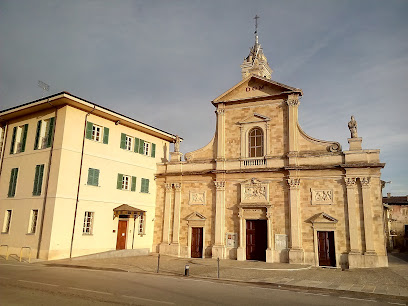
Spinetta – Square and Parish – Cuneo
Europe,
Italy,
Cuneo,
Welcome to the historic Piazza and Parish of Spinetta, a place that represents a fundamental part of the cultural identity of Cuneo. This area, located in a district of the city, is known for its characteristic architecture and its deep connection with the local community. The parish dates back to ancient times, showing traces of a history that goes back to the Middle Ages, but its true importance is manifested not only through the structures but also in the social and cultural impact it has had over the centuries. The square serves as a hub of daily life, a place of meeting and celebration, perfectly integrated into the historical and urban fabric of Cuneo. The history of Spinetta is intrinsically linked to that of the entire Cuneo area. The earliest historical documents attest to the presence of a community here as early as the 12th century, but the origins of the parish can probably be traced back to the 14th century. With the expansion of the population and the growing need for places of worship, the church of Spinetta became an essential landmark for the faithful in the area. Over time, the parish underwent various transformations. An important renovation took place in the 1600s, when the church was expanded to meet the growing needs of the community. The original structure, smaller and simpler, adapted to a Baroque architectural style, which was highly appreciated throughout Italy during that period. This style is characterized by decorative elements and elaborate details, and Spinetta was no exception. Another significant remodeling dates back to the 19th century, when restoration and adaptation works were carried out that preserved and enhanced the historical elements of the church, introducing new ones in line with the trends of the time. Between 1870 and 1900, many works of art were commissioned to embellish the interiors, contributing to its contemporary charm. During the 20th century, the parish of Spinetta underwent the upheavals of wars and social changes. Despite the difficulties, the community came together to preserve the place of worship, and the church continued to be an important center for religious and social activities. In recent decades, the parish has embarked on a process of renewal and enhancement, aiming for greater community involvement and openness to visitors. Through cultural events, concerts, and initiatives, Spinetta has reaffirmed its role as the beating heart of the district, keeping its historical tradition alive. When you arrive at the Piazza and Parish of Spinetta, you will find yourself in front of a place that is both simple and extraordinary. The first thing that strikes you is the facade of the church, in Baroque style. The architecture presents elegant symmetry with stucco decorations flowing along the sides. You will find a central portal, topped by a curvilinear pediment, that splendidly interprets classical forms. As soon as you enter the church, on the left, you can admire a fresco representing the Madonna with Child. This painting is attributed to a local artist and plays a fundamental role in the devotion of the community. The light filtering through the stained glass windows creates a mystical atmosphere, inviting reflection. Proceeding further inside, on the right, you will observe the main altar, which features a significant work of art: an altarpiece depicting the Patron Saint of the community. This work, by a 19th-century artist, is characterized by delicacy in colors and mastery in details. Don’t miss the special attention given to the angels accompanying the main figure. In the center of the nave, it is captivating to notice the wooden ceiling, a true masterpiece of carpentry art, which tells stories of saints and biblical scenes, making the experience three-dimensional. This ceiling is not just a decorative element but testifies to the skill of the master craftsmen of the past. Exploring further, you will find a small chapel dedicated to Saint Joseph, an intimate corner of great spirituality for the faithful. This chapel is enriched by finely carved wooden statues that reflect the religious fervor of the local population. The artworks displayed here show a particular attachment to the daily life aspects of the people. Outside the church, the square serves as a meeting place. The porticos surrounding it create a welcoming space where markets and folk festivals are frequently held. Here, it is possible to observe local life, appreciating the interactions between residents and visitors, revealing the vibrancy of the neighborhood. Taking a step back, the overall view of the square will leave you speechless. The surrounding landscape, with the hills of the Langhe in the background, makes Spinetta not only a center of social life but also a corner of natural beauty. Throughout the different seasons, the square takes on unique colors and atmospheres, from the green of spring to the warm tones of autumn. The Piazza and the Parish of Spinetta are not isolated in the broader context of Cuneo, but are set within a rich history and culture. The district of Spinetta is surrounded by other significant places, such as the Parco della Resistenza, a site of memory and celebration that serves as an important gathering place for commemorative events. Let us not forget the nearby Museum of Genomics, dedicated to biodiversity and scientific innovation, a clear example of how tradition and modernity can live together in harmony. Finally, just a short distance away, we find the Castle of Cuneo, an example of military architecture with a remarkable history, enriching the journey into the culture of Cuneo. These places, just a few steps from Spinetta, are an invitation to continue discovering the historical and natural heritage that characterizes this region. One of the most interesting curiosities related to the parish of Spinetta is the fact that many local artists have found inspiration for their works within the church. This tradition continues today, with artists performing in concerts and cultural events, helping to keep the artistic community alive. Furthermore, the square is an important reference point during the patronal feast held every year, attracting residents and visitors to celebrate local culture through music, dance, and culinary traditions. Finally, the architecture of the church presents a mix of elements typical of European architecture, making it a unique example of the stylistic variety present in Piedmont.
Read More