St Augustine Gate - Viewpoint - Bergamo
Europe,
Italy,
Bergamo,
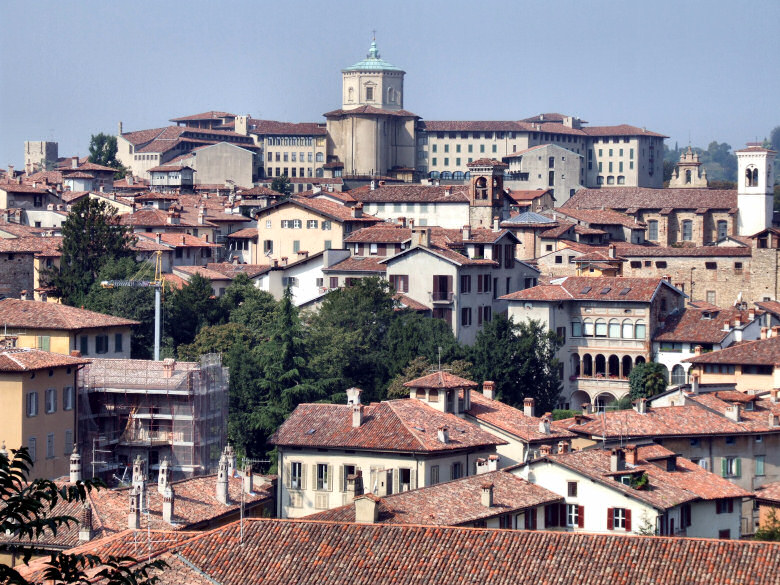
Porta Sant’Agostino represents one of the most evocative landmarks in Bergamo, an important passage between the lower town and the upper town. Built in the 16th century, this monumental gate is known not only for its imposing architecture but also for the breathtaking panorama it offers of the underlying plains. Its construction, which took place between 1525 and 1532, fits within the period of military fortification representation typical of the Republic of Venice, which governed Bergamo at that time. The gate, as well as a viewpoint, is today a gathering place and a favored observation point of the historic town.Origins and History The origins of Porta Sant’Agostino date back to the period of Venetian domination, an era during which it was decided to strengthen the city’s defenses with prestigious architectural works. The decision to build a new gate, which was meant to replace an older and less secure one, answered the need to adapt the city walls to new war strategies.In 1525, the Council of Bergamo approved the project by architect Giovanni Battista Baratta, who designed an imposing gate in Renaissance style that could reflect the power of the Republic. The work was completed in 1532, and from that moment on, Porta Sant’Agostino became one of the main access routes to the upper town.Over the centuries, the gate has undergone various transformations and restorations. In the 19th century, with the unification of Italy, the structure was subject to some maintenance interventions. However, its exterior appearance has largely remained true to the original, allowing visitors to appreciate the beauty of Bergamo’s Renaissance.During World War II, Porta Sant’Agostino was damaged, but thanks to careful restoration work in the 1950s, the gate was able to regain its ancient splendor. In recent decades, the area around the gate has been redeveloped, making this place not only a historical passage but also a social gathering area.What to Observe As you approach Porta Sant’Agostino, you will be struck by its majestic façade. Here, Renaissance architecture meets defensive needs, creating a perfect blend of beauty and utility. The entrance is characterized by a large arch, flanked on either side by two Doric columns that support a decorated cornice. This is a clear example of how military architecture can be elegant and decorative.Once you pass through the gate, be sure to look up. You will notice two large, elegant apses that overlook a wide view of the Bergamo plains. This detail highlights not only the strategic importance of the gate but also the choice to include elements that could enchant travelers.To the left, before descending the staircase leading to the viewpoint, you will find a niche with a statue of Saint Augustine. This figure, the patron saint of philosophers and theologians, represents a constant inspiration for those who wish to reflect on existence. The statue is a fundamental element that recalls Bergamo’s religious and cultural roots.Don’t forget to stroll along the viewpoint. From here, the panorama is truly extraordinary. The lower town stretches out before you with its various architectural styles. You can observe the terracotta roofs, the squares, and in the background, the morphology of the Bergamo hills. Here, natural beauty perfectly merges with human intervention, creating a postcard-worthy landscape.Continuing our tour, on the right side of the gate, you can notice some interesting architectural details. The small openings, resembling loopholes, are a tangible sign of the structure’s defensive function. These elements show how architecture can communicate power and protection.Finally, let’s close with the view from the staircase. When you descend, take a moment to observe the floral ornaments that adorn the parapet. This is further proof of the fusion between functionality and beauty, a aspect highly appreciated in the Italian Renaissance.Context and Connections Porta Sant’Agostino is not only a historical passage but also fits into an urban context rich in history. Located at the entrance to the upper town, it represents a crossroads between different eras and architectural styles. Not far away, you will find the Castle of San Vigilio, another witness to Bergamo’s military history. This fortification offers an additional observation point of the city and represents an architectural wonder not to be missed.Near Porta Sant’Agostino is also the Church of San Giovanni Battista, which represents an interesting example of Baroque architecture. This church is easily reachable and deserves a visit for its frescoes and the serene atmosphere that characterizes it.Finally, as you continue towards the upper town, you will encounter Piazza Vecchia, the beating heart of Bergamo, where history can be felt in every corner. Here you can admire the Palazzo della Ragione and the Civic Tower, which are among the most emblematic monuments of the city.Curiosities Defensive Function: The gate did not only serve as an access point to the city but had a strategic function. It was designed to withstand attacks during periods of conflict, attesting to the real defensive needs of the city in the 16th century.A Meeting Place: During the restoration of the 1950s, Porta Sant’Agostino became a meeting place for young locals, transforming into a symbol of the city’s social life.Integration with the Walls: Porta Sant’Agostino is an integral part of the ancient Venetian walls, declared a UNESCO World Heritage site in 2017. These walls represent an exceptional example of military engineering.We invite you to continue your discovery of Bergamo by visiting the nearby Castle of San Vigilio, a place of history and nature, and to stop by the Church of San Giovanni Battista, a Baroque masterpiece that will enchant you with its beauty. Enjoy your visit!
Read More