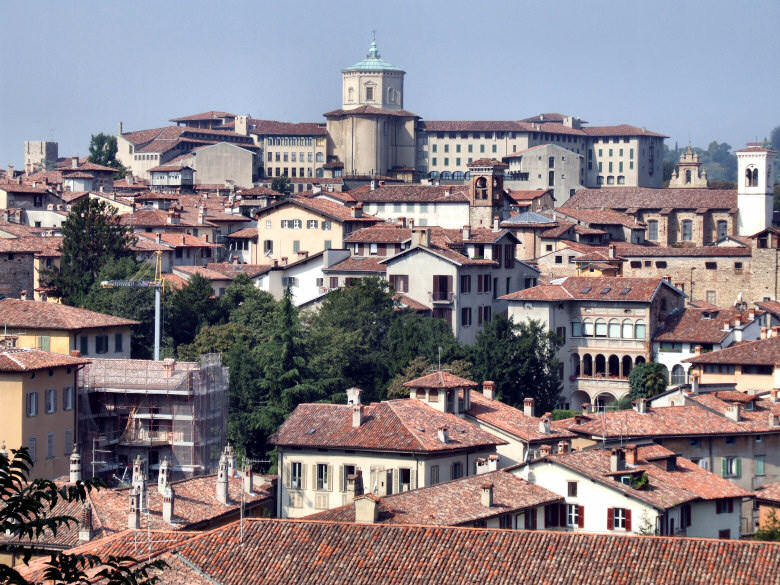
St Augustine Postern - Bergamo
Europe,
Italy,
Bergamo,
The Pusterla of Sant’Agostino is a fascinating example of defensive architecture that embodies the historical identity of Bergamo. Located in the Lower Town, this gate traces its roots back to the medieval period, approximately in the 13th century, and represents an important testimony of the fortifications developed for the city’s defense. It is known for its distinctive architectural style and the role it has played over the centuries, allowing access for residents and travelers to the Upper Town. Unlike the larger city gates, the Pusterla is more intimate, yet no less significant.Origins and HistoryThe Pusterla of Sant’Agostino dates back to the 13th century, during the period of the Ghibelline lordship in Bergamo. Pusterle, literally “small doors”, were strategic buildings designed to ensure rapid and secure access to the city. The Pusterla of Sant’Agostino is named after the surrounding environment and a church of the same name dedicated to Saint Augustine, known in medieval times.Over time, many of these structures underwent significant transformations. Initially, the Pusterla also served as a checkpoint for goods and people entering and leaving the city. Its strategic position, adjacent to the city wall, granted it considerable importance, and its functions as a checkpoint were maintained for centuries.During the Renaissance, the architecture of the Pusterla underwent restoration interventions. These works aimed not only to consolidate the structure but also to refine its aesthetics, reflecting the evolution of taste in architecture. It was during this period that the gate was reinforced to adapt to new defensive needs arising with the advent of firearms. Thus, the Pusterla of Sant’Agostino, despite its medieval essence, mirrored the socio-economic and political-military changes of the city.Although somewhat neglected in the following centuries, today the Pusterla of Sant’Agostino has been the subject of enhancement and recovery programs, making it a place of interest for tourists and art historians. It is a symbol not only of Bergamo’s architectural history but also of its resilience and adaptability.What to ObserveAs you approach the Pusterla of Sant’Agostino, the solidity of its walls immediately strikes you. The facade, made of limestone, is characterized by a full arch, typical of medieval architecture. On the architrave of the entrance, you can spot engravings and decorations that testify to the importance of the gate in the past. Notice the small openings in the walls: in medieval times, these served to monitor passage and, if necessary, to protect against external dangers.Upon entering, to your left, you can admire one of the ancient guardrooms. This space, formerly used by guarding soldiers, has been preserved with some period elements. If you look closely, you will also notice the traces of ancient arrow slits, a characteristic that emphasizes the defensive function of the structure.Moving towards the inner courtyard, the contrast between the imposing gate and the intimacy of the space surrounding the Pusterla is striking. Here, there is also a view of the surrounding landscape, which once served to monitor the territory.Another element to note is the small chapel dedicated to Saint Augustine, located in the immediate vicinity of the gate. This church, although no longer used as a place of worship, represents another piece of the city’s religious history. Completing the architectural observation is a slender bell tower that invites visitors to look up and notice the decorative details that slowly fade into the clouds.Finally, be sure to admire the remains of some ancient wall writings, strategically placed along the path. These inscriptions tell stories of past generations and imbue the stones of the Pusterla of Sant’Agostino with meaning.Context and ConnectionsThe Pusterla of Sant’Agostino is set within an urban context rich in history and culture. Located a short distance from the Church of Sant’Agostino, an important example of ecclesiastical architecture, it represents a junction between the religious and civil life of the time.Continuing the visit, nearby stands the Piazzetta del Bersagliere, which offers an inviting space for a break and to enjoy the view over Bergamo. Additionally, not far from here is the Museum of the Sixteenth Century, another place rich in works and stories to discover.The Lower Town and Upper Town, connected by a system of stairways and streets, create a continuum of historical and cultural experiences that can also be explored on foot. This provides the opportunity to understand how Bergamo has developed over the centuries, both architecturally and socially.CuriositiesThe Pusterla of Sant’Agostino is not only an important architectural testimony but has also gained attention for several historical events. A notable curiosity is linked to the fact that during the plague of the 14th century, the gate was used as a quarantine point. This was a method to control and limit the spread of the disease, marking a dramatic yet important period for the city.Another curiosity concerns its function as a meeting place for merchants and travelers. It was here that, in past centuries, contracts and trade agreements were often made, giving rise to a sort of informal market.Finally, it is worth mentioning the restoration that occurred in the 1990s, which uncovered frescoes and decorations previously hidden. This recovery work has opened the door to new studies and a better understanding of the role of this pusterla in the daily and defensive life of Bergamo.
Read More