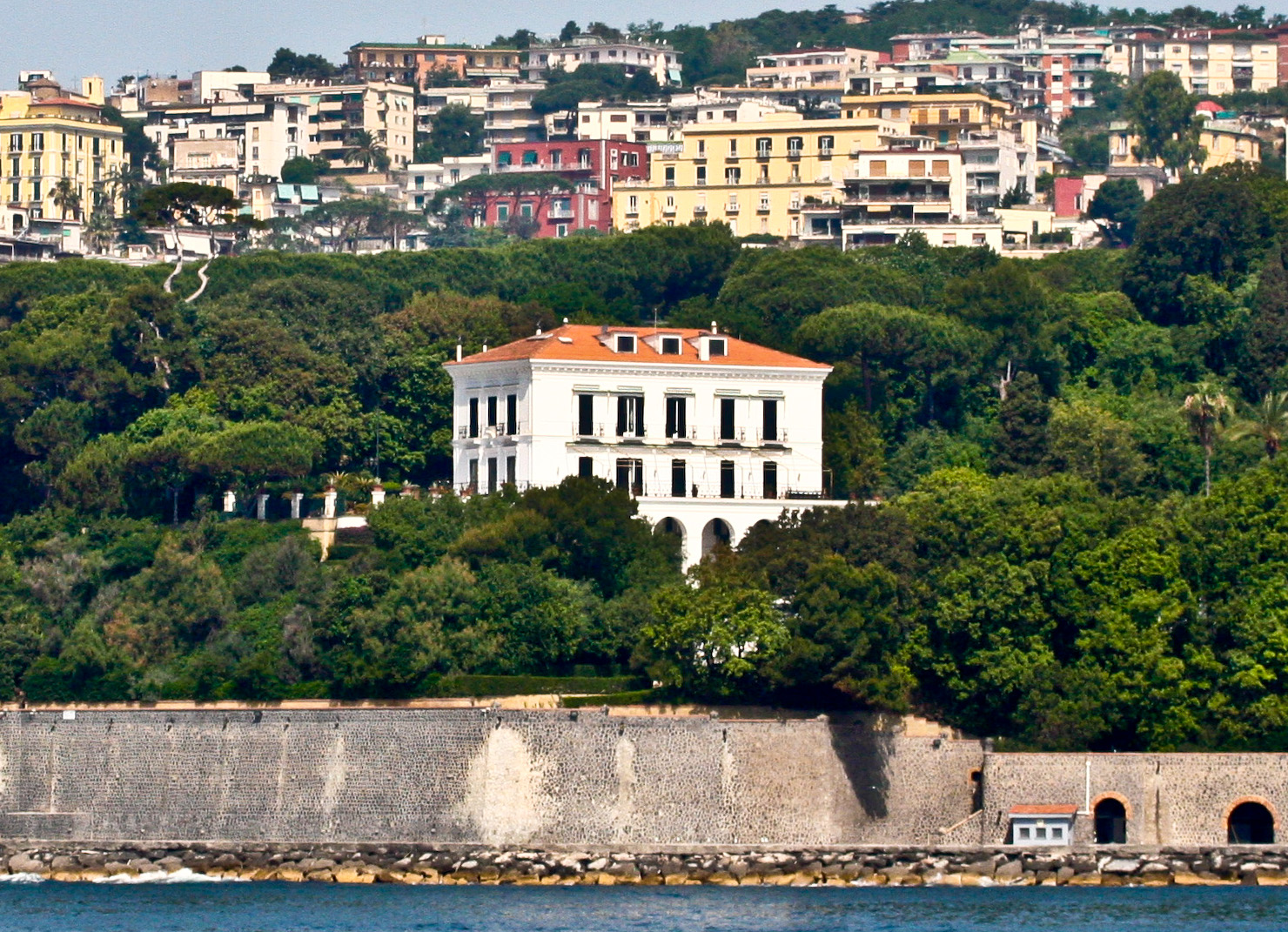
Villa Rosebery
Europe,
Italy,
citta,
San Carlo all'Arena
Villa Rosebery, located on the Posillipo hill in Naples, is one of the three official residences of the President of the Italian Republic, along with the Quirinal Palace and the Castelporziano estate. The villa, covering an area of 6.6 hectares, is surrounded by a lush park with a breathtaking view of the Gulf of Naples.
The origins of the villa date back to 1801, when it was built as a cottage in the garden of the Belvedere at the request of Count Joseph von Thurn, an Austrian officer in the service of the King of Naples. Subsequently, the property was expanded and transformed during the 19th century by Don Agostino Serra di Terranova, who renamed it Casino Gaudioso. After Don Agostino’s death in 1857, the villa passed to Luigi di Borbone, Count of Aquila, who renamed it La Brasiliana in honor of his brother-in-law, Emperor Pedro II of Brazil.In 1897, the villa was purchased by Archibald Primrose, 5th Earl of Rosebery and former British Prime Minister. During his ownership, the villa underwent further modifications and improvements. In 1909, Lord Rosebery donated the villa to the British government, which used it as the residence for the British ambassador in Italy until 1932, when it was transferred to the Italian government. Since then, Villa Rosebery has been used as the summer residence of the Italian royal family until the end of the monarchy in 1946. During the brief reign of Vittorio Emanuele III, the villa served as his refuge until his abdication in 1946.After World War II, the villa was used by the Italian Aeronautical Academy until 1949, when it fell into disuse for a period. In 1957, it was finally designated as the official residence of the President of the Italian Republic, a function it still holds today. Today, Villa Rosebery is only open to the public on special occasions, such as FAI (Italian Environment Fund) days, allowing visitors to explore its beautiful gardens and historic interiors.Architecturally, Villa Rosebery is a neoclassical masterpiece designed by the Gasse brothers, Stefano and Luigi. The main villa, known as the Palazzina Borbonica, is surrounded by other historic buildings including the Grande Foresteria, used to accommodate distinguished guests. The interiors of the villa are characterized by elegant decorations, with stuccoes and frescoes reflecting the opulence of the Bourbon period and the eclecticism of the 19th century.The park surrounding the villa is equally fascinating, designed in English style with a variety of exotic and native plants. Walking through the gardens, visitors can admire fountains, sculptures, and panoramic terraces offering spectacular views of the sea and the city of Naples. The care of the park has been constant over the years, preserving its original beauty.An interesting episode related to the villa concerns its use during the period of the Italian Social Republic, when it was briefly occupied by the Nazis and used as a residence for German officers. This turbulent period has left a mark in the history of the villa, making it a place of memory as well as beauty.
Read More