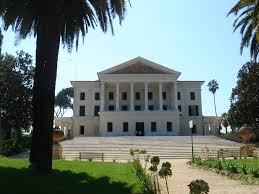
Villa Torlonia
Europe,
Italy,
citta,
Rione XVII - Sallustiano
Villa Torlonia, located along Via Nomentana in Rome, is a splendid example of a noble residence and historic park, which tells the story of the Torlonia family and the architectural transformations that took place from the 19th century onwards. This villa was initially an agricultural property of the Pamphilj family and later of the Colonna family, before being purchased in 1797 by the banker Giovanni Torlonia. It was he who transformed it into a luxury residence thanks to the work of the architect Giuseppe Valadier.
Valadier redesigned the Casino Nobile, the main building of the villa, giving it a neoclassical elegance that still makes it one of the most refined examples of this style in Rome today. Between 1802 and 1806, Valadier transformed the small Casino Abbati into an elegant building (now Casino dei Principi) and built the Stables and an imposing entrance, which was later demolished with the expansion of Via Nomentana. Valadier also designed the park with symmetrical and perpendicular avenues around the palace, furnishing it with numerous classical works of art.Upon Giovanni’s death, his son Alessandro continued the embellishment work, expanding the villa with new buildings and enriching the gardens in a romantic style. He commissioned the painter and architect Giovan Battista Caretti to build the False Ruins, the Temple of Saturn, the Tribune with Fountain, and an Amphitheater. Alessandro also involved two other architects, Quintiliano Raimondi and Giuseppe Jappelli, who respectively built the Theater and the Orangery (now Limonaia) and redesigned the southern area of the villa with lakes, exotic plants, and the charming Casina delle Civette, originally a Swiss hut.The Casina delle Civette, transformed in the following years into a masterpiece of Art Nouveau, is one of the most fascinating buildings of Villa Torlonia. With its curved lines, floral decorations, and artistic stained glass windows, it represents a unique example of this style in Rome. Its name derives from the numerous depictions of owls that adorn the structure, symbolizing wisdom and nocturnal beauty.In the 20th century, the villa became famous for being the official residence of Benito Mussolini, who settled there in 1925. Mussolini made some modifications, including the construction of a bunker and the installation of a private airstrip. During World War II, the villa suffered damage due to the Allied command’s occupation, but despite this, it retained its charm.After the war, Villa Torlonia fell into a state of neglect until, in 1978, it was acquired by the Municipality of Rome and opened to the public. In the 1990s, a series of restoration projects brought the villa and the park back to their former glory. Today, Villa Torlonia is a public park that houses several museums and cultural spaces, offering visitors a unique experience of art, history, and nature.The park of the villa still retains its original charm thanks to the English-style gardens and artistic furnishings scattered throughout the park. Among the various buildings that can be visited, in addition to the Casino Nobile and the Casina delle Civette, there are the Casino dei Principi, the Limonaia, and the Serra Moresca. The latter, built between 1839 and 1840 by Jappelli, is a garden pavilion in Moorish style, inspired by the architecture of the Alhambra in Granada, with polychrome stained glass windows and iron and cast iron structures.
Read More