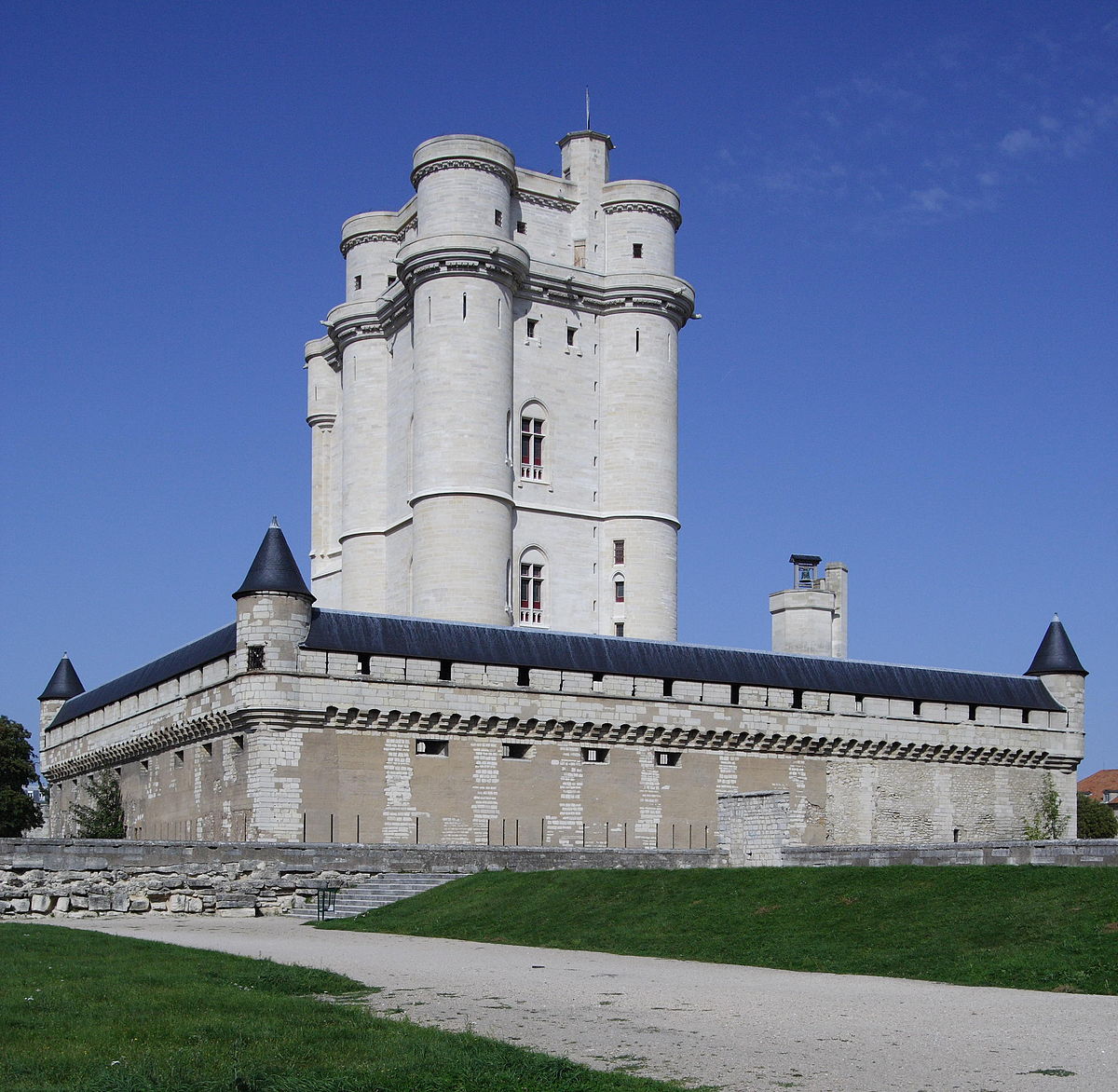
Vincennes Castle
Europe,
France,
citta,
Vincennes
The Castle of Vincennes, located east of Paris, is one of the most important and imposing medieval castles in Europe. This majestic fortress, with its 52-meter-high watchtower, played a crucial role in French history, serving as a royal residence, state prison, and administrative center. Today, the Castle of Vincennes is a silent witness to the political, artistic, and social changes that have crossed France from the Middle Ages to the present day.
The origins of the castle date back to the 12th century, when King Louis VII decided to build a hunting lodge in the forest of Vincennes, a vast wooded area that then surrounded Paris. This lodge was progressively expanded by his successors, until it became a true royal residence under Philip II Augustus. The strategic location of the site, a few kilometers from the capital, made it ideal for hunting activities and for political and administrative meetings.The Castle of Vincennes reached its peak under the reign of Charles V in the 14th century when it was transformed into an imposing fortress. Charles V, known for his interest in architecture and fortifications, commissioned the construction of the keep, a massive watchtower that still dominates the skyline. With its 52 meters in height, the keep of Vincennes is the tallest medieval tower in Europe and a symbol of power and authority.The rectangular layout of the castle is surrounded by a deep moat and imposing curtain walls, giving the fortress an impregnable appearance. Inside the walls are various buildings, including the Sainte-Chapelle, a Gothic chapel built to house the relics of the Passion of Christ. Inspired by the Sainte-Chapelle in Paris, the chapel of Vincennes is a jewel of Gothic architecture, with stained glass windows that illuminate the interior with a celestial light.The castle was the residence of numerous French monarchs, including Philip IV the Fair, Louis IX (Saint Louis), and Charles VI. During the reign of Louis IX, the castle also became a center of culture and learning, hosting a royal library and welcoming scholars and artists. Saint Louis is known for holding some of his famous theological discussions here, reflecting his deep interest in religion and philosophy.Over the centuries, the Castle of Vincennes has undergone numerous changes and adaptations. During the religious wars of the 16th century, the fortress was reinforced and adapted to new military needs. Subsequently, under the reign of Louis XIV, the castle gradually lost its function as a royal residence, being used mainly as a state prison. Among the illustrious prisoners held at Vincennes were the philosopher Denis Diderot and the revolutionary Mirabeau.One of the most dramatic episodes in the history of the castle occurred during the French Revolution when the site was the scene of violent clashes. In 1791, a crowd of Parisians, suspecting that the castle was being used to hide counter-revolutionary weapons and ammunition, attacked the fortress. Although no weapons were found, the episode marked the beginning of a period of decline for the castle.
In the 19th century, the Castle of Vincennes was transformed into a military barracks and arsenal. During this period, many of the original buildings were modified or demolished to make way for new military structures. However, thanks to conservation efforts initiated in the 20th century, much of the castle’s historical and architectural heritage has been preserved.Today, the Castle of Vincennes is a historic monument open to the public and a site of great tourist interest. Visitors can explore the keep, with its historic rooms and panoramic views, visit the Sainte-Chapelle, and stroll through the vast gardens surrounding the castle. The site also hosts temporary exhibitions and cultural events, which help to keep its rich historical heritage alive.A curious anecdote concerns the architect Le Nôtre, famous for designing the gardens of Versailles. It is said that Le Nôtre, during the design of the castle’s park, was inspired by the forest of Vincennes, seeking to harmoniously integrate the surrounding nature with the formal architecture of the gardens. This innovative approach has influenced many other landscaping projects throughout Europe.
Read More