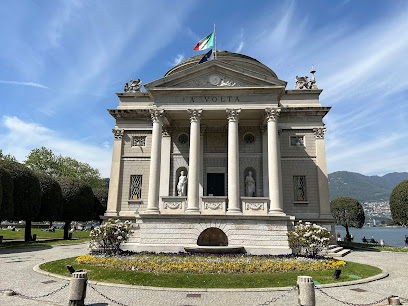
Volta Temple, Como
Europe,
Italy,
Como,
Welcome to Como, a city that fascinates with its beauty and history. Here, in the heart of this lakeside location, stands the Tempio Voltiano, a monument dedicated to one of Italy’s most illustrious scientists: Alessandro Volta. This building was inaugurated in 1928 and represents a tribute not only to Volta himself but also to the significance of his most famous invention, the battery. The construction, built in neoclassical style, is not only a place of commemoration but also a center of scientific culture. As we venture through this journey, we will discover together its origins, the works contained within, and the cultural context that makes it a fundamental element of Como’s identity. The history of the Tempio Voltiano begins in 1927, when it was decided to honor Alessandro Volta on the centenary of his death. The project was entrusted to the local architect Federico Frigerio, who conceived a building that reflected Volta’s scientific significance. The choice of location, on the shores of Lake Como, is not incidental: Volta himself was deeply connected to these places, where he spent a large part of his life. The Tempio Voltiano is an example of neoclassical architecture. The facade is characterized by a portico with columns and a high pediment, which confer an air of grandeur and solemnity. The portico is supported by six Ionic columns, symbolizing strength and stability, and the monument itself is built from travertine, a material reminiscent of the temples of ancient Rome. Inside, the Temple is divided into various sections housing different exhibitions dedicated to the life and works of Volta. Among the significant events in its history, in 1930, the structure was enriched by numerous original artifacts belonging to Volta, partially donated by his family. After World War II, the Temple underwent various restoration and expansion works to keep the memory of the great scientist alive. In 1993, the museum was renovated to make it more accessible and interactive. In every corner of the Temple, one breathes a passion for science and innovation, a legacy that Volta has left not only to Italy but to the entire world. In 2015, the Temple was included in the “Places of Science” circuit by the Ministry of Education, University, and Research, as a testimony to its cultural and educational value. As soon as you enter the Tempio Voltiano, you are welcomed by an atmosphere of grandeur and respect. The first element that the visitor notices is the central monument dedicated to Alessandro Volta. This bust, created by the local sculptor Davide Calì, is surrounded by numerous informational panels that tell the story of the physicist and his discoveries. Moving to the right, you can observe the display case of scientific instruments, an extraordinary collection that includes some of the instruments designed by Volta and his contemporaries. Among these, the electric circuit and the electrometer stand out, essential devices for experiments on electricity. Continuing along the exhibition pathway, you arrive at the hall of inventions, where numerous models representing Volta’s creations are collected. Here, particular reference is made to the battery, the first electric generator in history. The battery not only revolutionized physics but also had a significant impact on many current technologies. To your left, don’t forget to admire the paintings and portraits of Volta that decorate the walls. These artworks are not only beautiful to see but also narrate the cultural legacy of the great scientist. The portraits show Volta in crucial moments of his life, reflecting his status as a scientist and innovator. Climbing to the upper floor, a panoramic view of Lake Como and the surrounding mountains opens up. This panorama is not only a viewpoint but also a tribute to the natural wonders that Volta loved. It is said that he drew inspiration from the beauty of the surrounding locations for his discoveries. Returning to the ground floor, don’t forget to pay attention to the architectural elements of the Temple. The Ionic columns, the frescoed ceiling, and the marble floors are all indicators of the craftsmanship that went into the making of this building. Every detail, from the choice of materials to the lighting, has been meticulously thought out to honor the figure of Alessandro Volta. Finally, you cannot leave the Temple without visiting the outdoor garden, a small oasis of peace surrounding the building. Here you will find busts and statues of other scientists, further emphasizing the value of science and research. The Tempio Voltiano fits perfectly into Como’s cultural and historical context. The city, famous for its lake and as a getaway for many illustrious personalities, is also a hub of innovation and science. Just a short walk from the Temple, you’ll find the Paolo Giovio Archaeological Museum, which offers a rich panorama of the city’s ancient history, from its origins to the Roman age. This museum is an excellent complement to a visit to the Temple, serving as a place for reflection on the continuity of culture and science in Como. Additionally, nearby, Villa Olmo deserves a visit. This neoclassical palace is not only an example of early 19th-century architecture but also hosts cultural events and exhibitions. The villa, with its gardens overlooking the lake, represents another aspect of Como’s cultural wealth. Finally, the Teatro Sociale di Como is another important landmark. This historic theater has hosted operas, concerts, and significant cultural events over the years. Its architecture and history make it an ideal place to explore the art and culture that, alongside science, form the soul of this city. Did you know that Alessandro Volta also made significant discoveries in the field of psychology? His research on electric currents allowed him to examine the physiology of the nervous system and the human body’s reactions to electricity. Moreover, Volta was not only a physicist but also an innovator in the field of education. He founded the first school of physics in Como in 1779, underscoring the importance of scientific training. This aspect makes the Temple not only a place of memory but also a center for continuous education. Finally, the Tempio Voltiano regularly hosts events and conferences, transforming it into a meeting place between science and society. In this way, Volta’s legacy is kept alive, encouraging new generations to explore the wonderful world of science.
Read More