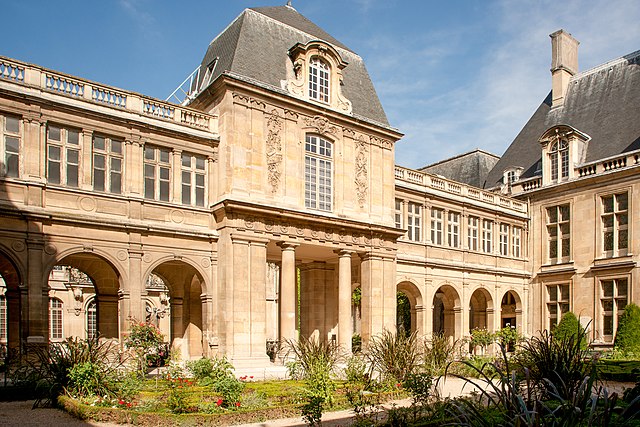
Carnavalet Museum
Europe,
France,
citta,
III arrondissement
The Carnavalet Museum, located in the heart of the Marais, one of the oldest and most fascinating neighborhoods in Paris, is entirely dedicated to the history of the city. The museum occupies two historic hôtels particuliers, the Hôtel Carnavalet and the Hôtel Le Peletier de Saint-Fargeau, and offers visitors a journey through the rich and varied history of Paris, from ancient times to the present day.
Founded in 1880, the Carnavalet Museum is one of the oldest museums in Paris. Its collection includes over 600,000 objects, ranging from archaeology to photography, painting to sculpture, furniture to decorative art objects. This vast assortment of works allows for a detailed and engaging recounting of the multiple transformations that have characterized the French capital over the centuries.The Hôtel Carnavalet, which gives its name to the museum, is a Renaissance building built in 1548 and renovated by the architect François Mansart in the 17th century. The building itself is an architectural masterpiece, with its elegant façades, inner courtyards, and gardens. Over the years, the Hôtel Carnavalet has hosted numerous illustrious figures, including Madame de Sévigné, a famous 17th-century letter writer, whose memory is honored with a dedicated room inside the museum.The Hôtel Le Peletier de Saint-Fargeau, annexed to the museum in 1989, dates back to 1688 and represents a perfect example of French classical architecture. The combination of the two buildings provides an ideal backdrop for the museum’s collections, which are organized in a chronological and thematic path.The visit to the Carnavalet Museum begins with sections dedicated to ancient Paris, including archaeological finds from the Gallo-Roman period, such as sculptures, ceramics, and mosaics. These objects offer a fascinating glimpse into the daily life of the inhabitants of Lutetia, ancient Paris, and testify to the city’s importance already in Roman times.Continuing along the path, visitors can explore the rooms dedicated to the Middle Ages and the Renaissance, with a rich collection of artworks, manuscripts, and everyday objects that illustrate life in medieval Paris. Particularly interesting are the reconstructions of domestic interiors, which allow visitors to immerse themselves in the atmosphere of the time and better understand the habits and lifestyle of Parisians back then.One of the highlights of the visit is the section dedicated to the French Revolution, a crucial period in the history of Paris and France. Here, visitors can admire portraits, prints, objects, and documents that recount the dramatic events of those years, from the storming of the Bastille to the proclamation of the Republic, to the rise of Napoleon Bonaparte. Among the most significant objects are the key to the Bastille, a model of the guillotine, and the furniture belonging to the protagonists of the Revolution.The Carnavalet Museum also devotes ample space to the 19th and 20th centuries, with sections documenting the city’s major urban and social transformations. Special attention is given to the works of Georges-Eugène Haussmann, the prefect who, under Napoleon III, redesigned Paris by creating the grand boulevards, parks, and new neighborhoods that still characterize the city today. Models, paintings, and photographs illustrate the radical changes that transformed Paris into a modern metropolis.The museum’s exhibition path also includes numerous artworks celebrating the cultural and artistic life of Paris. Paintings by renowned artists such as Eugène Delacroix, Gustave Courbet, and Jean-Baptiste-Camille Corot provide a glimpse into the Parisian artistic scene of the 19th century. Additionally, the museum houses a rich collection of photographs documenting the daily life and historical events of the city.An interesting anecdote concerns the room dedicated to Marcel Proust, the French writer famous for his cycle of novels “In Search of Lost Time.” In this room, Proust’s bedroom is reconstructed, with original furnishings and personal items that allow visitors to enter the writer’s intimacy and better understand his creative universe. This reconstruction is one of the most fascinating elements of the museum and attracts numerous literature enthusiasts.
Read More