Catacombs of Generosa
Europe,
Italy,
citta,
Portuense
The Catacombs of Generosa, located in the Portuense suburb of Rome, represent an interesting example of early Christian and pagan cemetery, with evidence dating back to late antiquity. The name derives from Generosa, the founder or donor of the land on which the complex was built. This archaeological site, excavated on a hill along the Tiber River, is developed on a single level and includes an ancient basilica, built by Pope Damasus I in the 4th century, and the martyrdom crypt, where the relics of the saints Simplicio, Faustino, Viatrice, and Rufiniano are preserved.
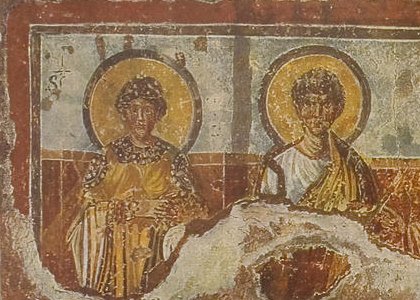
The catacomb was created for the burial of the martyrs Simplicio and Faustino, killed in 303 during the persecutions of Diocletian. According to tradition, their bodies were recovered by their sister Viatrice and buried in the catacomb. Some time later, Viatrice also suffered martyrdom and was buried next to her brothers. The martyrdom crypt, located behind the apse of the basilica, contains a Byzantine fresco from the 6th century, known as the “Coronatio Martyrum”. This painting depicts Christ handing the crown of martyrdom to Simplicio, accompanied by Viatrice, Faustino, and Rufiniano. The fresco has suffered various damages over time, but was restored in 1983.
The catacombs reveal a simple and poor style, reflecting the social condition of the peasants in the area. The ancient entrance was closed by a semi-subterranean basilica, the remains of which were discovered by Giovanni Battista de Rossi in the 19th century. The current entrance consists of a small brick structure with an iron door. The discovery of marble inscriptions in the 19th century sparked the interest of archaeologists, leading to the discovery of the catacomb in 1868.
During the Middle Ages, Pope Leo II transferred the relics of the martyrs of Generosa to the church of Santa Bibiana all’Esquilino, leading to the gradual abandonment of the catacomb. Further excavation campaigns in the 1980s allowed to establish the exact size of the above-ground basilica, which had three aisles divided by pillars.
The Catacombs of Generosa offer a unique insight into the religious and social life of early Christians and pagans in Rome. The site, which also includes the sacred grove of Magliana, with the ancient pagan college of the fratres Arvales, dedicated to the worship of the goddess Dia, testifies to the coexistence and interaction between different faiths in antiquity. The marble tablets used by the Arval brothers to record their religious life were reused as paving slabs in the basilica of Generosa, demonstrating the reuse of ancient materials in Christian contexts.
The martyrdom crypt and the semi-subterranean basilica are the focal points of the site, but the entire complex is worth a visit for its historical and artistic richness. The inscriptions and frescoes, despite the damage suffered over the centuries, continue to tell stories of faith, sacrifice, and hope, making the Catacombs of Generosa a place of great importance for those who wish to fully understand the cultural and spiritual heritage of Rome.
Read More