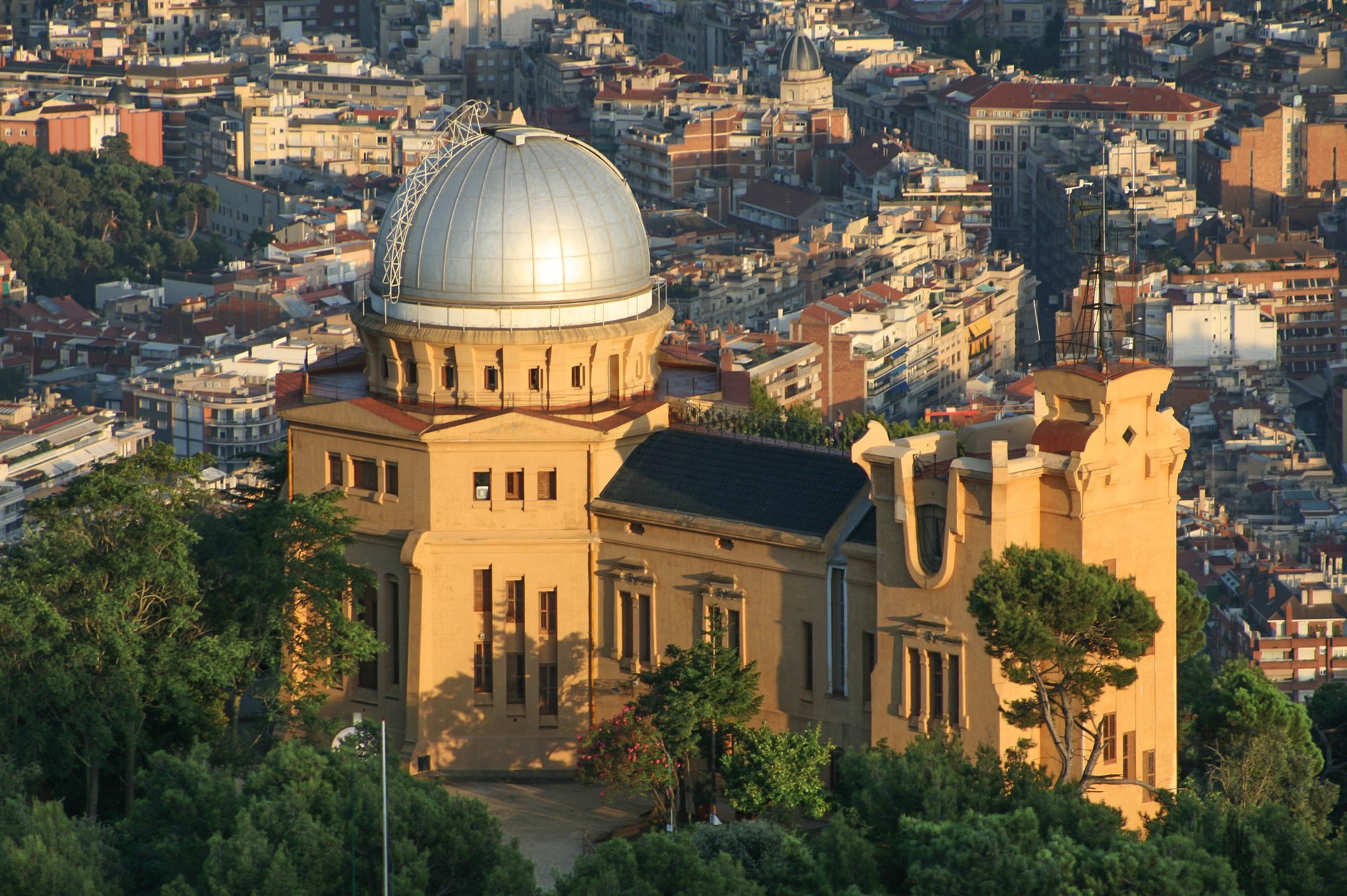
Fabra Observatory
Europe,
Spain,
Barcelona,
Collserola
The Fabra Observatory, located on the slopes of Tibidabo in Barcelona, is one of the oldest astronomical observatories still in operation in the world. Inaugurated in 1904 in the presence of King Alfonso XIII, the observatory is named after its main benefactor, the industrialist and politician Camil Fabra i Fontanills, Marquis of Alella. The Fabra Observatory is owned by the Reial Acadèmia de Ciències i Arts de Barcelona (RACAB), an institution that played a crucial role in its creation and management.
The structure was designed to accommodate studies in astronomy, meteorology, and seismology, reflecting Catalonia’s scientific ambitions at the beginning of the 20th century. Built during a period of great enthusiasm for science and technology, the observatory has made significant contributions to knowledge in these fields. Among its most notable discoveries is the detection of an atmosphere on Titan, one of Saturn’s moons, made by the observatory’s director, Josep Comas i Solà.
From an architectural point of view, the building is an example of elegance and functionality. Designed according to the canons of neoclassical architecture, it features a sturdy structure and clean lines, perfectly integrated into the surrounding natural landscape. Its privileged position on Tibidabo not only offers spectacular views of Barcelona but also ensures ideal conditions for astronomical observation, away from the city lights.
The interior of the observatory houses historically valuable instruments, including a large refracting telescope built in Paris by Mailhat in 1904. This telescope, still in use, has an aperture of 38 cm and has allowed for high-quality observations. In addition to the telescope, the observatory has a Baker-Nunn camera, used for photographing small asteroids and comets.
In recent decades, the Fabra Observatory has been able to renew itself, adapting to the needs of the scientific community and the public. It regularly organizes guided tours, conferences, and educational activities for schools and families. One of the most appreciated experiences is the “Sopar amb Estrelles” (Dinner with the Stars), an event that combines a dinner under the stars with nighttime astronomical observations, allowing participants to admire planets, stars, and other celestial objects through the historic telescope. The Fabra Observatory was declared a Cultural Heritage of National Interest in 2014, a recognition that highlights its historical, scientific, and cultural importance. This status protects the building and ensures its preservation for future generations, ensuring that it continues to be a center of scientific excellence and a symbol of Catalan cultural heritage.
Read More