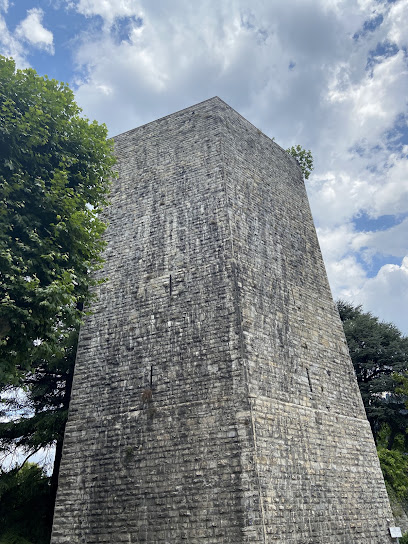
Gattoni Tower, Como
Europe,
Italy,
Como,
The Gattoni Tower is an emblematic element of the city of Como, encapsulating centuries of history and culture. Located in the heart of the historic center, this tower dates back to a period when Como was establishing itself as an important commercial and strategic center during the Middle Ages. The tower is known for its distinctive architecture and as one of the few remnants of the ancient city fortifications, which testify to the defensive importance of the city. Its construction dates back to the XIII century, but there have been numerous interventions that have changed its appearance over time. The Gattoni Tower was built in the XIII century, precisely during a time when the city of Como was going through an important phase of economic and political development. It was part of the city’s fortifications, designed to defend Como from enemy attacks. This architectural element is not just a tower, but a symbol of the power and political autonomy of Como, which managed to maintain its independence during those years, despite being surrounded by foreign and sometimes hostile powers. The architecture of the tower reflects the typical characteristics of the period, with a stone structure that makes it robust and suitable for resisting both external attacks and the elements. In the following centuries, the Gattoni Tower underwent various restoration and transformation works. A significant renovation occurred in the XIV century, when Como became a city-state and further developed its fortifications. During this period, the tower was further incorporated into the defensive walls, increasing its strategic value. Over the centuries, the Gattoni Tower witnessed numerous historical events, including conflicts between local noble families, such as the Visconti and the Rusconi. Starting from the XV century, with the Swiss and later Spanish domination, the function of the tower changed from a military outpost to a symbol of an increasingly unstable power. In the XX century, the tower was recognized as a monument of historical and artistic interest and underwent enhancement interventions to preserve its architectural features. Today, the Gattoni Tower is not only a historical testimony but also a landmark in the city of Como, highly appreciated by tourists and locals who enjoy strolling in its surroundings and admiring its majesty. As we approach the Gattoni Tower, the first thing that strikes us is its imposing presence. The façade, made of gray stone, rises strong and austere, a sign of its defensive past. Right in front, we can see the large entrance door, topped by a pointed arch. This type of architecture is typical of medieval fortifications and serves to provide stability to the entire structure. Continuing along the side of the tower, to our right we can glimpse small windows that once served as loopholes. These openings allowed the defenders to scout the horizon and, if necessary, defend themselves in case of an attack. The loopholes are an important element for understanding the function of the tower within the context of its walls, indicating a wise use of space for defense. Entering inside the tower, we find ourselves in a rather austere environment, where the medieval atmosphere is palpable. The thick walls delineate spaces that seem to tell past stories. Here, light filters through small openings, creating shadows that amplify the sense of mystery. In the center of the room, we notice a stone fireplace, a testimony to the use of the tower as a refuge during the most turbulent times. Ascending the spiral staircase that leads us to the upper floor, we can admire the exposed wooden beams, which contribute to giving an idea of the original structure and the craftsmanship of the time. These details recall the artisanal tradition of the area, with high-quality workmanship typical of the medieval period. Reaching the highest floor, a stunning panoramic view opens before us. From here, we can admire the entire city of Como and the beautiful lake that surrounds it. This privileged viewpoint was also crucial for monitoring potential enemy incursions, making the tower a strategic lookout point. Finally, we cannot forget to observe the architectural details that adorn the façade of the tower, such as the small carvings, typical of medieval constructions, which tell stories and symbols related to the city of Como. The Gattoni Tower is located in the heart of Como’s historic center, surrounded by a series of historic buildings and monuments that enrich its context. Just a short walk away is the Como Cathedral, one of the most important examples of Gothic architecture in Italy, whose construction began in 1396 and represents one of the city’s wonders. Next to the Cathedral, we also find the Cathedral Square, a lively meeting point where other historical structures, such as the Broletto, which was formerly the seat of the city government, can be admired. Another place of great interest nearby is the Teatro Sociale, inaugurated in 1813, an example of neoclassical architecture that has hosted numerous cultural and musical events over the years. This venue contributes to enriching the cultural offerings of Como, making the visit to the Gattoni Tower even more significant, in the context of an area rich in history and culture. From here, we also invite you to discover Villa Olmo, an extraordinary neoclassical villa overlooking the lake, which is just a few minutes’ walk from the tower. The latter is surrounded by a marvelous park, perfect for a stroll in nature and history. One of the curiosities related to the Gattoni Tower is its name. “Gattoni” may derive from an ancient noble family from Como that, according to some sources, once lived there. This connection with local nobility signifies the importance of the tower not only as a defensive element but also as a symbol of power. Another curiosity is that the Gattoni Tower is part of a complex of historical buildings that have undergone changes of use over the centuries. During certain historical phases, in fact, the tower was used as a storage facility and later as a residence for the caretakers, thus concealing its military past. Finally, it is said that where the Gattoni Tower now stands, there was once a Roman temple, confirming the strategic importance of this site since ancient times.
Read More