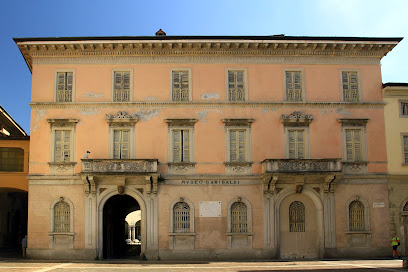
Giuseppe Garibaldi Historical Museum, Como
Europe,
Italy,
Como,
Welcome to the Giuseppe Garibaldi Historical Museum in Como, an institution that plays a fundamental role in the identity of the city and in the historical memory of Italy. Founded in 1911, the museum is dedicated to the figure of Giuseppe Garibaldi, one of the main protagonists of the unification of Italy, known for his extraordinary military leadership and fervent patriotism. Garibaldi spent significant periods of his life in Como, contributing to the Risorgimento history with his bold enterprises and vision of a united Italy. Here you can explore not only his connection to the city but also the turbulent and fascinating context of the 19th century, a period in which the museum was born and developed. The Giuseppe Garibaldi Historical Museum is located in a building of great historical value, dating back to the 18th century. The choice of Como as its location is deeply symbolic; the city has witnessed numerous events related to Garibaldi’s life and the Risorgimento. The museum was inaugurated on November 4, 1911, coinciding with the celebration of the 50th anniversary of the Battle of Varese, where Garibaldi distinguished himself as one of the most influential military leaders of his time. Over the years, the museum has undergone various transformations and restorations to keep the historical memory alive. In the 1930s, thanks to the interventions of the Superintendency for Monuments, new exhibition rooms were added, expanding the collection and making it more accessible to the public. Furthermore, in the 1990s, a renovation project was undertaken that improved the exhibition spaces and facilities, aiming to better highlight the conserved cultural heritage. One of the most fascinating features of the museum is its archive, which preserves letters, documents, and original memorabilia of Garibaldi and his fellow soldiers. These historical documents provide a valuable insight into the life of the hero of the two worlds and his exploits, contributing to making this museum an important center for Risorgimento studies. In addition to the focus on Garibaldi, the museum also houses a variety of works of art and historical objects from the Risorgimento period, helping to provide a broader context on the significance of Italian unification, a complex process that involved various regions and cultures of the country. Upon entering the museum, you will be welcomed by an introductory section that presents the historical importance of Garibaldi. Here you will find a series of informative panels and a short video that contextualize the Risorgimento period. Continuing on, to your right, you will notice the bust of Garibaldi, made of marble, which represents the figure of the general in all his determination and charisma. This bust was sculpted in 1882 by the artist Giovanni Battista Giovenale. As you proceed through the exhibition path, you will find yourself in front of the first thematic room, dedicated to Garibaldi’s campaigns. Here are displayed uniforms, weapons, and other artifacts used during the famous battles. The particular attention to the details of these uniforms reflects not only Garibaldi’s military greatness but also the human aspect of the fighters, often driven by ideals of freedom and justice. On the left side of the second room, you can admire a series of historical paintings depicting significant moments in Garibaldi’s life. Among these, there is a large painting portraying the Battle of Calatafimi, a crucial episode of the Unification of Italy. This painting, created by an anonymous artist of the time, captures vivid and emotional details, conveying the intensity of the conflict. Moving towards the third room, look up: the walls are adorned with a selection of historical flags, symbols of the various factions and Italian regions involved in the Risorgimento. The flags, with their bright colors, not only tell the story of those years but also serve as a testimony to the patriotism and desire for unity among the Italian people. On the right, as you continue, you will find a room dedicated to Garibaldi’s friends and colleagues. Here, a series of portraits and biographies of figures like Giuseppe Mazzini and Vittorio Emanuele II offer a comprehensive view of the political and social landscape of the time. The interactions between these characters were fundamental for the assignment of roles and responsibilities and provide further understanding of the growth of the idea of nationalism in Italy. Don’t forget to visit the garden outside the museum, where several sculptures commemorating key figures of the Risorgimento are located. This green space, in addition to being a place of reflection and recreation, represents a direct link to Garibaldi’s history and his love for freedom. At the end of your visit, I recommend taking a last look at the museum’s small bookshop: here you will find a selection of volumes that delve into the history of Garibaldi and the Risorgimento, perfect for those who want to continue exploring these themes. The Giuseppe Garibaldi Historical Museum is situated in the heart of Como, a city rich in history and culture. Its strategic location makes it accessible to all and facilitates encounters with other historical attractions. Just a short walk away is the Como Cathedral, a masterpiece of Gothic architecture, whose construction began in 1396 and was completed in 1740. This magnificent building is a testament to the faith and determination of the people of Como. You should also consider visiting Villa Olmo, a beautiful neoclassical villa with a park overlooking Lake Como. The villa is known for its art exhibitions and cultural events, offering another opportunity to immerse yourself in the history and beauty of the area. Finally, it is worth mentioning the Voltiano Temple, dedicated to Alessandro Volta, a renowned physicist from Como, which celebrates the scientific and engineering discoveries of the city. Its proximity to the museum creates an interesting dialogue between history and science, two sides of the coin of Como’s culture. An interesting fact concerns the famous Garibaldi uniform, worn by Garibaldi during his campaigns. This uniform, consisting of a red jacket, white trousers, and a wide-brimmed hat, has become a symbol of rebellion and freedom throughout Italy. Even today, this style is evoked in various commemorative events dedicated to the patriot. Moreover, the museum holds several autographed letters written by Garibaldi himself. These documents are not only historical testimonies but also provide a glimpse into the man beyond the myth, revealing his fears and hopes for Italy and its people. Finally, Garibaldi’s figure is so powerful that his image continues to be used around the world to represent the concept of the struggle for freedom and emancipation. His love for freedom has inspired movements in other countries, making him a truly universal figure in the fight against oppression.
Read More