Capitoline Museums
Europe,
Italy,
citta,
Rione X - Campitelli
The Capitoline Museums, located on the top of the Capitoline Hill in Rome, represent one of the oldest and most fascinating museum complexes in the world. Their history begins in 1471, when Pope Sixtus IV donated to the Roman people a collection of important ancient bronzes, including the famous Capitoline Wolf, the symbol of Rome. This generous act marks the birth of the world’s first public museum, a place destined to preserve and display the wonders of Roman art and history.
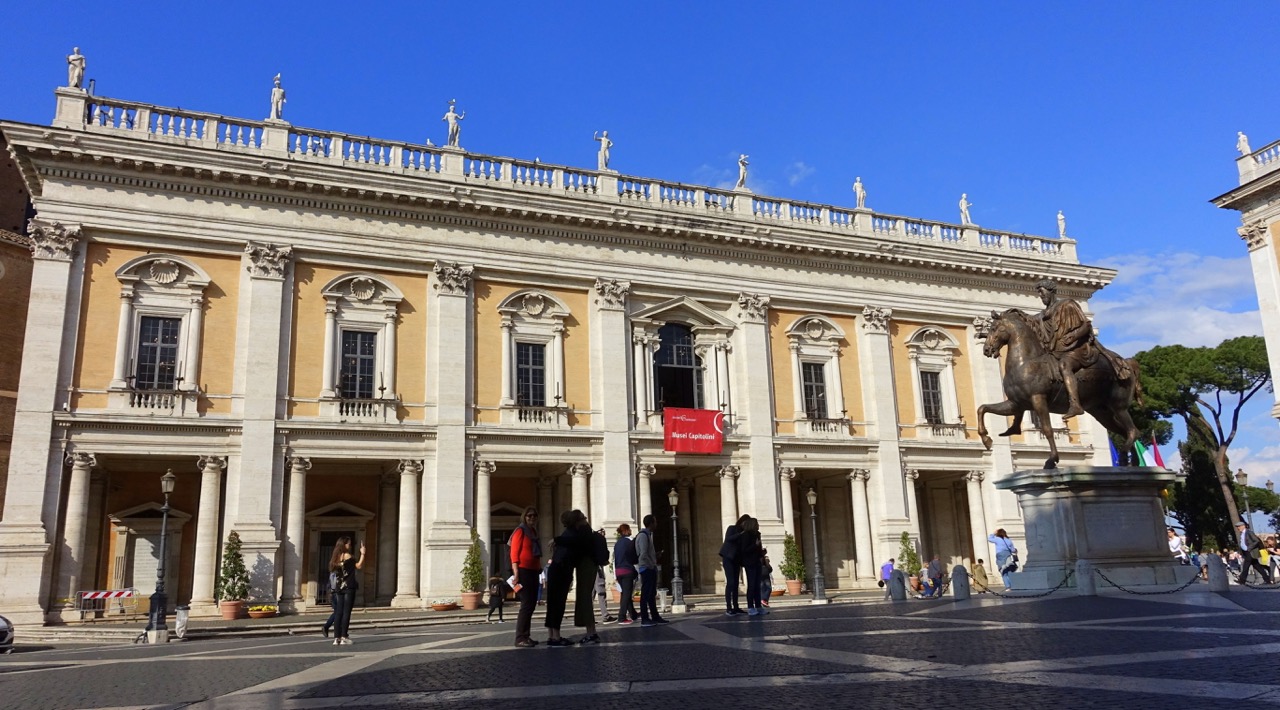
The complex of the Capitoline Museums is composed of three main buildings: the Palazzo dei Conservatori, the Palazzo Nuovo, and the Palazzo Senatorio, which together surround the splendid Piazza del Campidoglio, designed by Michelangelo Buonarroti in the 16th century. This square, with its trapezoidal shape and the majestic equestrian statue of Marcus Aurelius in the center, is a masterpiece of harmony and beauty, a true gem of Renaissance architecture.
The Palazzo dei Conservatori, one of the main buildings of the complex, houses a vast collection of ancient sculptures, including the famous “Spinario,” a statue of a young man extracting a thorn from his foot, and the “Capitoline Brutus,” a bronze bust of great expressive power. This palace, which over the centuries has been the seat of city magistrates, also houses important frescoes decorating the reception rooms, such as those in the Hall of the Horatii and Curiatii, which celebrate the glories of the Roman Republic.
The Palazzo Nuovo, built in the 17th century to complete the symmetry of the Michelangelo square, is known for its collections of classical sculptures. Here are works of extraordinary beauty such as the “Capitoline Venus,” one of the most famous depictions of the goddess of love, and the “Dying Gaul,” a moving representation of a mortally wounded Gallic warrior. This palace also houses the Lapidary Gallery, an underground corridor connecting the various buildings of the complex and displaying inscriptions and architectural fragments of great historical interest.
The Palazzo Senatorio, the historic seat of the city government, is another fundamental element of the Capitoline Museums complex. This building, built on the ruins of the ancient Tabularium, the State archive of ancient Rome, has been renovated over the centuries to adapt to the needs of the modern city. Its facade, with the monumental double-ramp staircase, is one of the most recognizable elements of the Capitoline square.
Among the most famous works preserved in the Capitoline Museums stands out the equestrian statue of Marcus Aurelius. This bronze statue, which for centuries was mistakenly identified as a representation of Constantine the Great, is the only equestrian statue of a Roman emperor that has come down to us. The original statue is now preserved inside the museum, while a faithful copy dominates the center of the square.
In addition to the sculpture collections, the Capitoline Museums also house a rich art gallery with works by artists such as Caravaggio, Rubens, Titian, and Guido Reni. Among the masterpieces on display are Caravaggio’s “Saint John the Baptist,” a painting of extraordinary intensity and realism, and Pietro da Cortona’s “The Rape of the Sabine Women,” a work that celebrates a legendary episode in Roman history.
Another highlight of the Capitoline Museums is the “Capitoline Wolf,” a bronze sculpture from the 5th century BC depicting the she-wolf suckling Romulus and Remus, the legendary founders of Rome. This sculpture, which has become the symbol of the city, is exhibited alongside the “Capitoline Fasti,” an ancient calendar documenting Roman magistracies from 483 to 19 BC.
Read More