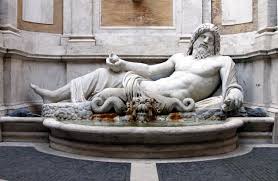
Statue of Marforio
Europe,
Italy,
citta,
Rione X - Campitelli
Marforio is one of the six talking statues of Rome, famous for being the vehicle of satire and social criticism from the 16th century onwards. This monumental statue, once located in the Forum of Augustus, is now in the courtyard of Palazzo Nuovo, one of the buildings of the Capitoline Museums. The history, art, and architecture surrounding Marforio are fascinating and complex, offering a deep insight into Roman culture through the centuries.
Marforio is a colossal marble statue depicting a reclining male figure, with typical features of a river deity. The statue measures about 3.75 meters in length and is carved from high-quality white marble. Its relaxed pose, with the right arm resting on a rock and the left holding an undefined object, gives the statue a majestic and tranquil air. Some art historians believe the statue represents the god of the Tiber River or Ocean, although the exact identification remains uncertain.
The statue of Marforio has a tumultuous history full of relocations. Originally placed in the Forum of Augustus, it was later moved near the Arch of Septimius Severus, then to the courtyard of the Palazzo dei Conservatori, and finally, in 1594, positioned in the courtyard of Palazzo Nuovo, where it still resides. During these relocations, the statue has been subject to various interpretations and has gained increasing cultural and political significance.
Marforio is perhaps best known for its role as a talking statue, a Roman tradition that involved posting satirical and critical verses on public monuments. These anonymous messages, known as “pasquinades” (named after another talking statue, Pasquino), were used to express popular discontent towards the powerful, criticize the clergy, or ridicule the social customs of the time. Marforio, in particular, became famous for its imaginary dialogues with Pasquino, creating a lively exchange of banter that reflected the opinions and concerns of Roman citizens.
The use of talking statues as a tool for political satire is a fascinating example of how public art can be reinterpreted and reused for social and political purposes. Marforio, with its imposing presence and role in popular culture, perfectly embodies this dynamic. Its function was not limited to urban decoration but became a means through which the Roman people could communicate and vent their dissent in an era when freedom of expression was severely limited.
From an artistic standpoint, Marforio represents an excellent example of imperial Roman sculpture. The quality of the marble and the craftsmanship are evident in the details of the face and body, showing a deep understanding of human anatomy and remarkable technical skill. The statue has been the subject of numerous studies and restorations over the centuries, with the aim of preserving its integrity and ensuring its accessibility for future generations.
An interesting anecdote about Marforio dates back to the 17th century when Pope Innocent X ordered the removal of the talking statues from public view to suppress the anonymous criticisms posted on them. However, the tradition of pasquinades was so ingrained in Roman culture that citizens continued to find ways to express their opinions, moving their messages to other statues and monuments.
Today, Marforio is an integral part of the exhibition path of the Capitoline Museums, where visitors can admire this extraordinary work of art up close and reflect on its complex and fascinating history. The statue is displayed in the courtyard of Palazzo Nuovo, surrounded by other ancient sculptures, which together offer an overview of the greatness and variety of Roman art.
Read More