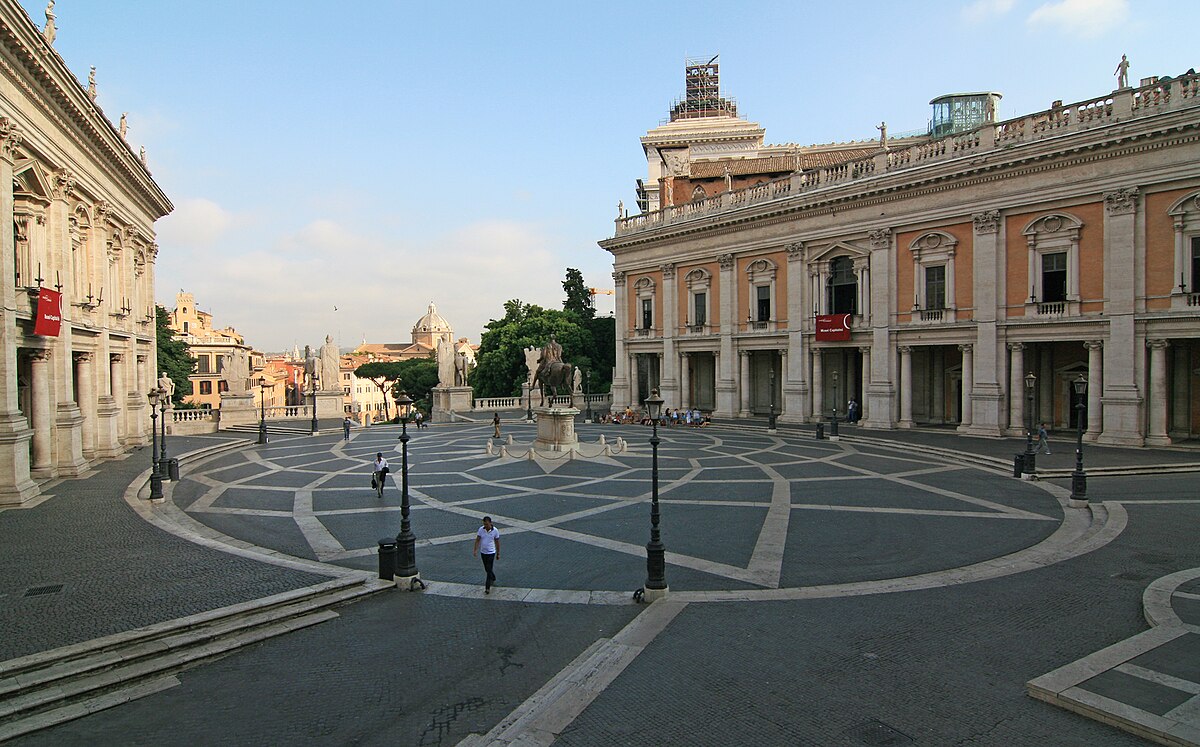
Campidoglio square
Europe,
Italy,
citta,
Rione X - Campitelli
Capitoline Hill, located on the Capitol Hill, is one of the most iconic and historically significant places in Rome. The square, as we see it today, is the result of the genius of Michelangelo Buonarroti, who in 1536 was commissioned by Pope Paul III to redesign this symbolic space to give new dignity to the seat of the city government. Michelangelo designed a trapezoidal square, dominated by a perspective game that guides the gaze towards the center, where the equestrian statue of Marcus Aurelius dominates.
The statue of Marcus Aurelius, one of the most respected emperors of antiquity, is a copy of the original bronze statue dating back to the 2nd century AD, now preserved in the Capitoline Museums to preserve its integrity. This choice was dictated by the will of Pope Paul III to underline the link between ancient imperial Rome and the papal Rome of the Renaissance, affirming the continuity of the power and greatness of the city.The square is surrounded by three palaces that form a harmonious and grand architectural ensemble. On the right is the Palazzo dei Conservatori, on the left is the Palazzo Nuovo, and in front is the Palazzo Senatorio. The latter, with its central tower, is the historic seat of the municipal government of Rome. The Palazzi dei Conservatori and Nuovo house the Capitoline Museums, the oldest public museum in the world, founded in 1471 by Pope Sixtus IV with the donation of a group of classic bronze statues.Access to the square is through the Cordonata, a monumental staircase designed by Michelangelo, conceived to be traversed even on horseback, reflecting the concept of accessibility and inclusivity of Renaissance architecture. At the base of the staircase are the statues of the Dioscuri, Castor and Pollux, while at the top, two Egyptian lions in black basalt add a touch of exoticism and antiquity.The paving of the square is another masterpiece by Michelangelo, with an elliptical design that creates a sense of movement and centripetism. The star pattern, made of white marble and travertine, guides the gaze towards the center, emphasizing the statue of Marcus Aurelius and creating a sense of cosmic order that reflects the Renaissance ideal of universal harmony.A curious anecdote concerns the choice of the statue of Marcus Aurelius. During the Middle Ages, it was mistakenly thought to represent the Emperor Constantine, the first Christian emperor, which probably saved the statue from being melted down, a fate common to many other bronze works of antiquity.The Capitoline Museums, overlooking the square, are an essential stop for those who want to deepen their knowledge of Roman art and history. Among the most famous works housed in the museums are the Capitoline Wolf, a symbol of Rome, the Dying Gaul, a masterpiece of Hellenistic art, and the Capitoline Venus, one of the most admired sculptures of antiquity.
Read More