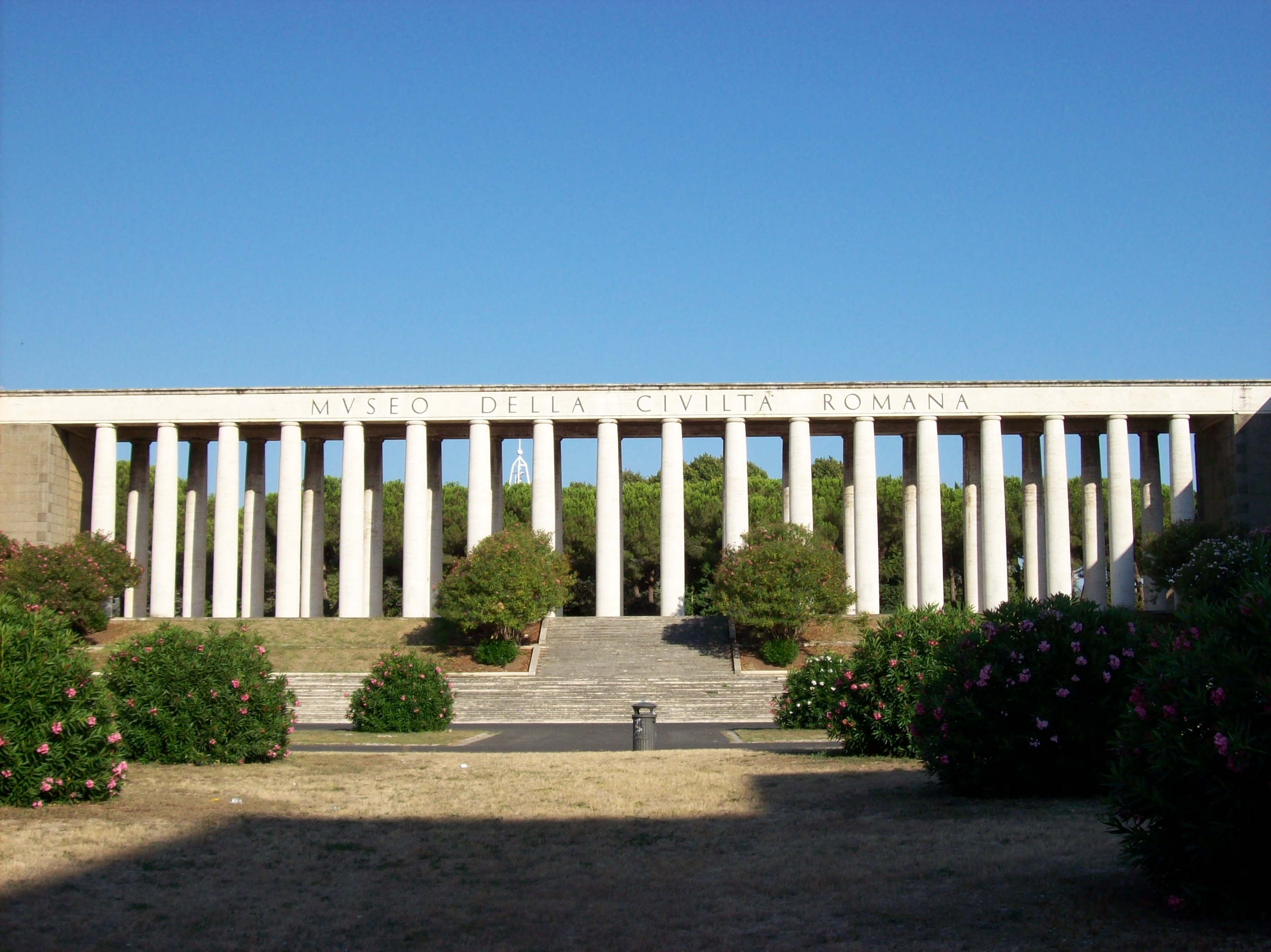
Museum of Roman Civilization
Europe,
Italy,
citta,
EUR
The Museum of Roman Civilization, located in the EUR district of Rome, is a unique institution that tells the history, art, and culture of ancient Rome through an extraordinary collection of casts, models, and reconstructions. Inaugurated on April 21, 1955, the museum offers an immersive journey into Roman civilization, with an exhibition that spans from the origins of Rome to the fall of the Empire.
The museum is housed in a building designed by architects Pietro Aschieri, Gino Peressutti, and Domenico Bernardini, and engineer Cesare Pascoletti. The structure is characterized by two lateral buildings connected by a scenic colonnade that conveys a sense of grandeur and solemnity. The choice not to have external windows allows visitors to fully immerse themselves in the atmosphere of ancient Rome, with natural light filtering from above through skylights, gently illuminating the exhibition rooms.One of the main attractions of the museum is the large model of imperial Rome, made on a 1:250 scale by architect Italo Gismondi. This model, representing Rome in the 4th century AD at the height of its urban expansion under Emperor Constantine, is a marvel of precision and detail. The model allows visitors to see the original appearance of iconic buildings such as the Colosseum, the Circus Maximus, the Imperial Forums, and the Pantheon, offering a unique perspective on the greatness of the empire’s capital.Another significant section is dedicated to casts of Trajan’s Column. The column, erected in 113 AD to commemorate Emperor Trajan’s victories against the Dacians, is famous for its detailed reliefs depicting military campaigns and the daily life of Roman soldiers. The casts of the reliefs allow for a close observation of the scenes depicted, with a clarity that is often not possible to appreciate on the original.The museum also offers a series of dioramas and life-size models reconstructing aspects of daily life and structures of ancient Rome. Among these, stand out the models of the Theatre of Marcellus, the Circus of Maxentius, and the Ludus Magnus, the great gladiator school located near the Colosseum. These reconstructions provide a clear idea of how urban spaces and entertainment venues in the city were organized.The museum’s exhibition path is divided into chronological and thematic sections. The chronological section guides visitors through the different epochs of Roman history, from mythical origins with Romulus and Remus to the decline of the Empire in the 6th century AD. Each room is dedicated to a specific period, with models, casts, and informative panels illustrating the main events and historical figures of that time.The thematic section, on the other hand, explores various aspects of daily life and material culture of the Romans. Themes covered include architecture, engineering, religion, domestic life, and agricultural techniques. This part of the museum also includes the reconstruction of Roman dwellings, complete with furnishings and utensils, offering a total immersion into the daily life of ancient Rome.A particularly interesting area is dedicated to sculpture and art. Here, visitors can admire copies of famous Roman statues, such as the Augustus of Prima Porta and the equestrian statue of Marcus Aurelius. These replicas, crafted with great skill, allow for an appreciation of the beauty and perfection of Roman art, which has deeply influenced Western culture.The museum is also an important center for research and documentation, with a specialized library that collects texts and publications on Roman civilization. Scholars and enthusiasts can access these resources to deepen their knowledge of ancient Rome and its many facets.Unfortunately, since 2014 the museum has been closed for necessary renovation works to secure the building and renew the exhibition facilities. Despite this closure, the Museum of Roman Civilization remains a fundamental stop for anyone wishing to understand the greatness and complexity of the Roman Empire. The hope is that the works can be completed as soon as possible, allowing visitors to return to explore this treasure of history and culture.
Read More