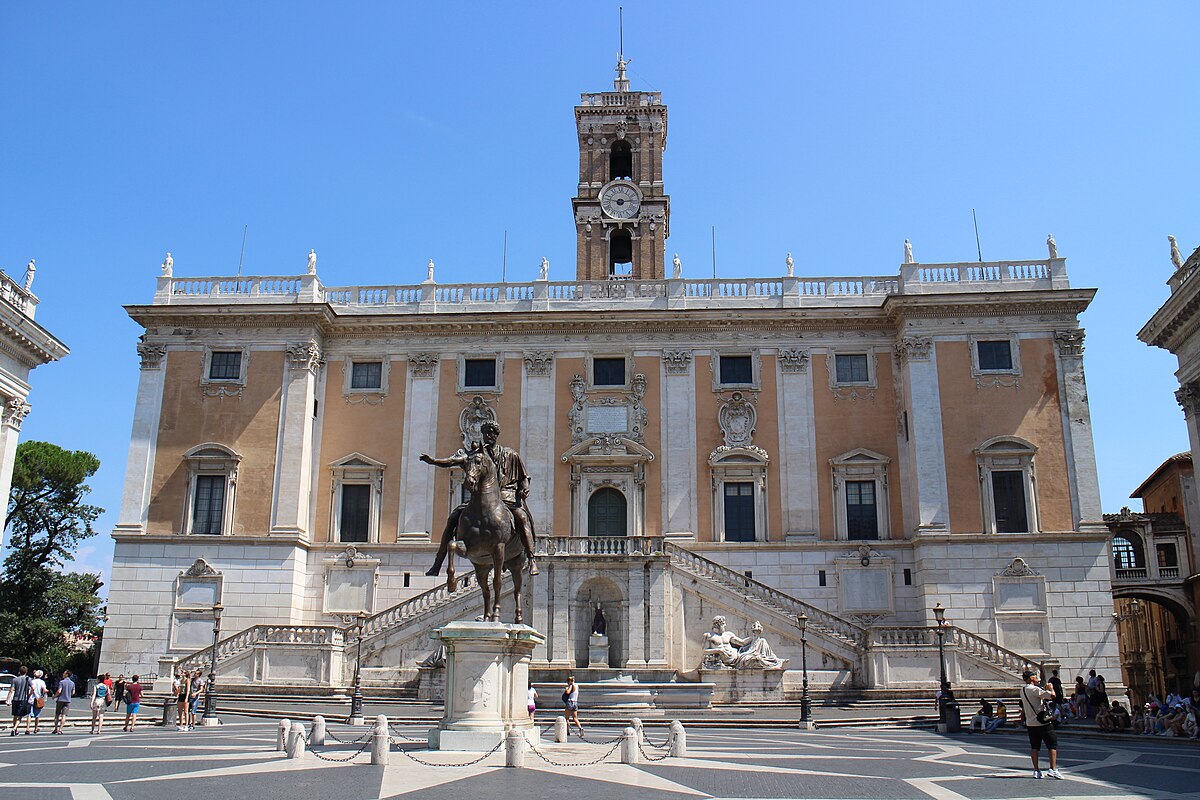
Senatorial Palace
Europe,
Italy,
citta,
Rione X - Campitelli
The Senatorial Palace, located at the top of the Capitoline Hill, is one of the most distinctive symbols of the civil power of Rome. Its complex and layered history reflects the architectural and political evolution of the city, from ancient times to the present day. Built between the 12th and 13th centuries on the ruins of the Roman Tabularium, the palace has played a central role in the administrative life of Rome since 1144, when it became the seat of the Roman Commune and the Senator, the authority responsible for the administration of justice and city interests.
The architecture of the Senatorial Palace is a fascinating mix of styles and historical periods. Initially, the palace featured a series of loggias with round arches arranged on three levels, overlooking the future Piazza del Campidoglio. These loggias were decorated with Ionic columns recycled from ancient buildings, a sign of the continuous interaction between ancient and modern that characterizes the entire complex.During the 14th century, the palace was transformed into a sort of fortress, with the addition of defensive towers commissioned by Popes Boniface IX, Martin V, and Nicholas V. The medieval tower, still visible today, is a reminder of these turbulent periods.A crucial moment in the history of the palace was the intervention of Michelangelo Buonarroti, between 1542 and 1554. Michelangelo redesigned the facade of the palace and designed the monumental double staircase that today is one of the most iconic elements of the structure. This staircase not only served as access to the new Senate hall but also acted as an elegant plastic connection between the square and the palace, and as an architectural backdrop for the two colossal ancient statues of the Nile and the Tiber.Michelangelo’s project for the Capitoline Hill, which included the Senatorial Palace, was completed by Giacomo della Porta, who continued the vision with details and embellishments. Martino Longhi the Elder completed the large bell tower between 1578 and 1582, adding another layer of magnificence to the palace. The bell tower, topped by the statue of the Goddess Roma, serves as a visual and symbolic landmark, representing the city’s ancient connection to its glorious past.In addition to its architectural function, the Senatorial Palace has significant historical and political relevance. In 1143, the establishment of the Roman Commune represented an attempt at political autonomy from papal powers, a movement marked by the symbolic ringing of the “Patarina” bell from the palace tower. This bell, which marked the meetings of the city council, became a symbol of the struggle for self-government and resistance to papal interference.Thanks to its strategic position on the Capitoline Hill, the palace has always enjoyed a privileged view of the city, a factor that has contributed to its historical importance. The Capitoline Hill itself, with its complex layering of ancient and modern structures, represents a microcosm of Rome’s history, where every stone tells a story of power, art, and culture.The rear facade of the palace, visible from the Roman Forum, still reveals the blocks of tuff and peperino used for the construction of the Tabularium in the 1st century BC. These architectural details offer a window into the city’s past and show how modern structures overlap with ancient remains, creating a continuous narrative of urban history.
Read More