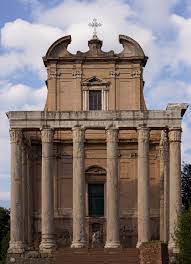
Temple of Antoninus and Faustina
Europe,
Italy,
citta,
Rione X - Campitelli
The Temple of Antoninus and Faustina, located in the Roman Forum, is one of the most imposing and well-preserved buildings of antiquity. Built in 141 AD by Emperor Antoninus Pius in honor of his deceased wife Faustina, the temple was later dedicated to the emperor himself after his death in 161 AD. The structure represents an extraordinary example of Roman architecture of the 2nd century and offers insight into the history, art, and religiosity of the time.
The temple stands on a high podium and overlooks the Via Sacra, the main street of the Roman Forum. The entrance is preceded by a monumental staircase and an impressive portico with ten Corinthian columns in cipollino marble, about 17 meters high. These columns, characterized by deep fluting and finely decorated capitals, support an architrave on which the original dedication is inscribed: “Divo Antonino et Divae Faustinae Ex S.C.” (to the divine Antoninus and the divine Faustina by decree of the Senate).The cella of the temple, built in blocks of peperino and clad in marble, features a pediment decorated with reliefs depicting mythological and symbolic scenes related to the deification of Faustina. Inside, the original marble decoration has undergone various looting and transformations over the centuries, but traces of stuccoes and polychrome marbles that adorn the walls are still visible.In the 7th century, the temple was converted into the church of San Lorenzo in Miranda, a fact that contributed to its preservation. The transformation into a church involved several structural changes, including the opening of windows in the cella and the addition of a Baroque facade, the work of architect Orazio Torriani in the 17th century. Despite these modifications, the original structure of the temple has remained largely intact, allowing visitors to appreciate Roman architecture in its almost original form.One of the most interesting anecdotes related to the temple concerns its denomination. The church of San Lorenzo in Miranda owes its name to the now abandoned hypothesis that it was founded by the Miranda family. This error persisted for centuries until more recent studies confirmed that the name was rather linked to the presence of a shrine of San Lorenzo near the temple.The temple is a significant example of the propagandistic use of architecture by Roman emperors. The dedication to Faustina, deified immediately after her death, and later to Antoninus Pius, is a clear example of how monuments were used to consolidate imperial cult and perpetuate the memory of emperors. This building was not only a place of worship, but also a symbol of power and Roman pietas, that is, the sense of duty and devotion to the gods, family, and state.The importance of the Temple of Antoninus and Faustina is also emphasized by the fact that it was one of the first buildings in the Roman Forum to be restored in the Renaissance. Humanists and artists of the time, such as Andrea Palladio, studied it carefully, considering it a model of architectural perfection. The reliefs and Corinthian columns of the temple deeply influenced Renaissance and Baroque architecture, as evidenced by the numerous sketches and drawings that have come down to us.The central position of the temple in the Roman Forum makes it a must-see for anyone wishing to understand the complexity and richness of ancient Rome. Its imposing columns and the grandeur of the portico offer a vivid impression of the grandeur of Roman architecture and the central role that these buildings played in the public and religious life of the time.
Read More