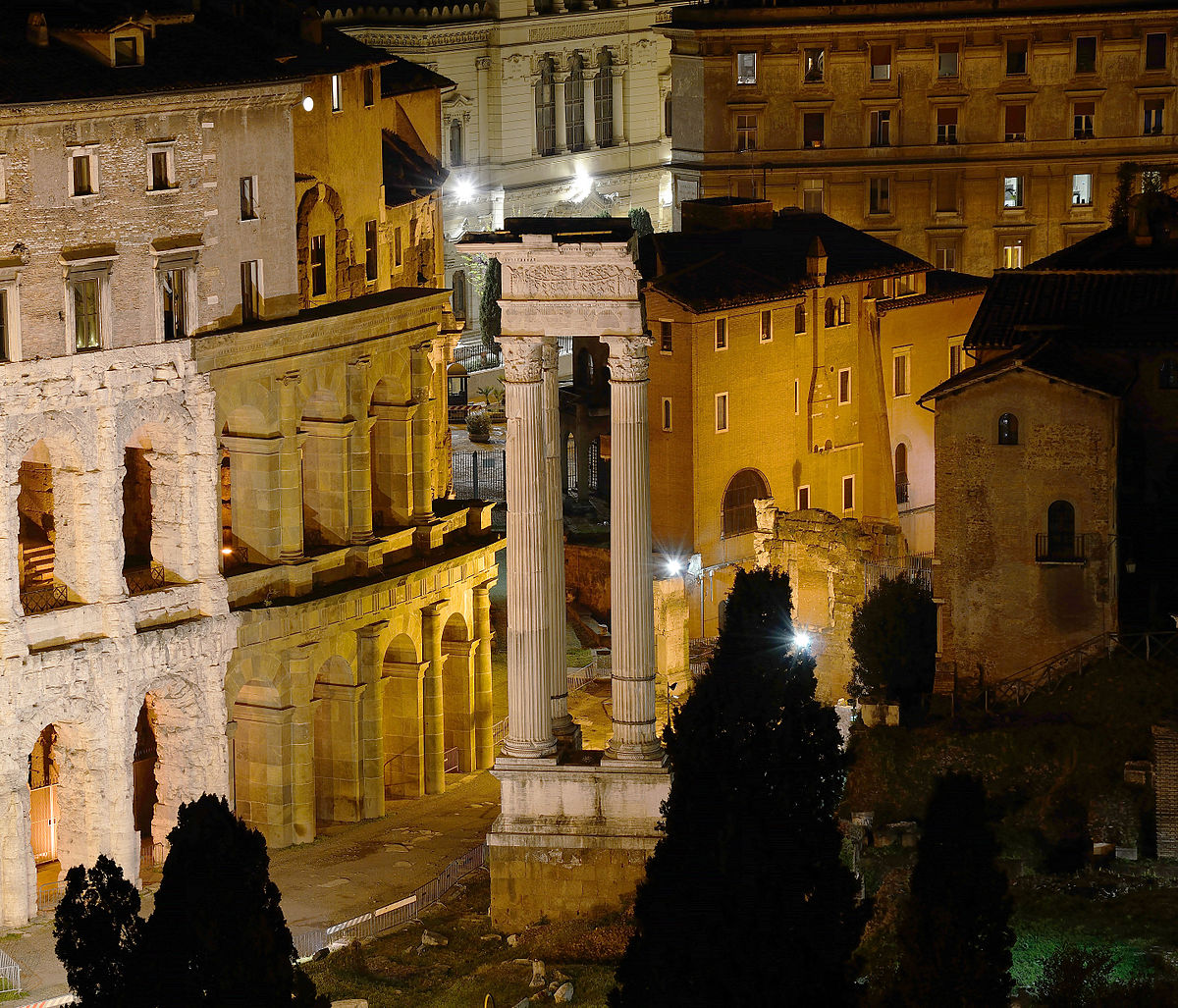
Temple of Apollo Sosiano
Europe,
Italy,
citta,
Rione X - Campitelli
The Temple of Apollo Sosiano, located in the Campus Martius in Rome, represents an extraordinary example of the fusion between Roman architecture and Greek influences. Its origins date back to the 5th century BC, when it was initially dedicated to Apollo Medicus in response to a plague that had struck Rome. The version of the temple that we can see today is the result of renovations ordered by Gaius Sosius, a Roman general, at the end of the 1st century BC.
The architecture of the Temple of Apollo Sosiano is a masterpiece that reflects the transition from the architectural traditions of the Roman Republic to the Hellenistic influences introduced during the Augustan period. The temple is almost perfectly oriented towards the south, a detail that distinguishes it from the surrounding buildings, including the nearby Temple of Bellona. The structure is characterized by a high platform (podium) built with travertine blocks, while the non-load-bearing parts are made of tuff and concrete.The columns of the temple’s facade, made of Carrara marble, are arranged in a hexastyle pattern (six front columns), which continues along the long sides of the pronaos. The rear columns, on the other hand, are made of brick plastered to look like marble. The frieze and architrave are decorated with detailed reliefs, made of marble slabs attached to the support structure. The Corinthian capitals of the temple feature extra vegetal motifs, giving it an elaborate and distinctive appearance.One of the most fascinating features of the Temple of Apollo Sosiano is its pediment, decorated with sculptures depicting the Amazonomachy (the battle between Greeks and Amazons), dating back to the Greek classical period (450-425 BC). These sculptures were brought to Rome during the Augustan period and are now housed at the Centrale Montemartini, a section of the Capitoline Museums. The cella of the temple, the inner part where the statue of the god was placed, was decorated with columns of African marble and frescoes celebrating the military victories of Octavian, the future Augustus.The historical context of the temple is equally fascinating. Gaius Sosius, who gave his name to the temple during its renovation, was a general and politician who, after being defeated in the Battle of Actium in 31 BC, was pardoned by Octavian. The contemporary construction of the Temple of Apollo on the Palatine Hill by Augustus and the renovation of the Temple of Apollo Sosiano can be seen as a symbol of the political dynamics and the cult of Apollo, embodying health and victory, themes dear to the Augustan regime.Over the centuries, the temple underwent several renovations and modifications, but much of its original structure has been preserved. The current remains include the podium and some fluted columns that offer a tangible impression of the grandeur of ancient Roman architecture. The location of the temple, near the Theatre of Marcellus and the Porticus Octaviae, places it in an area rich in historical and cultural significance.
Read More