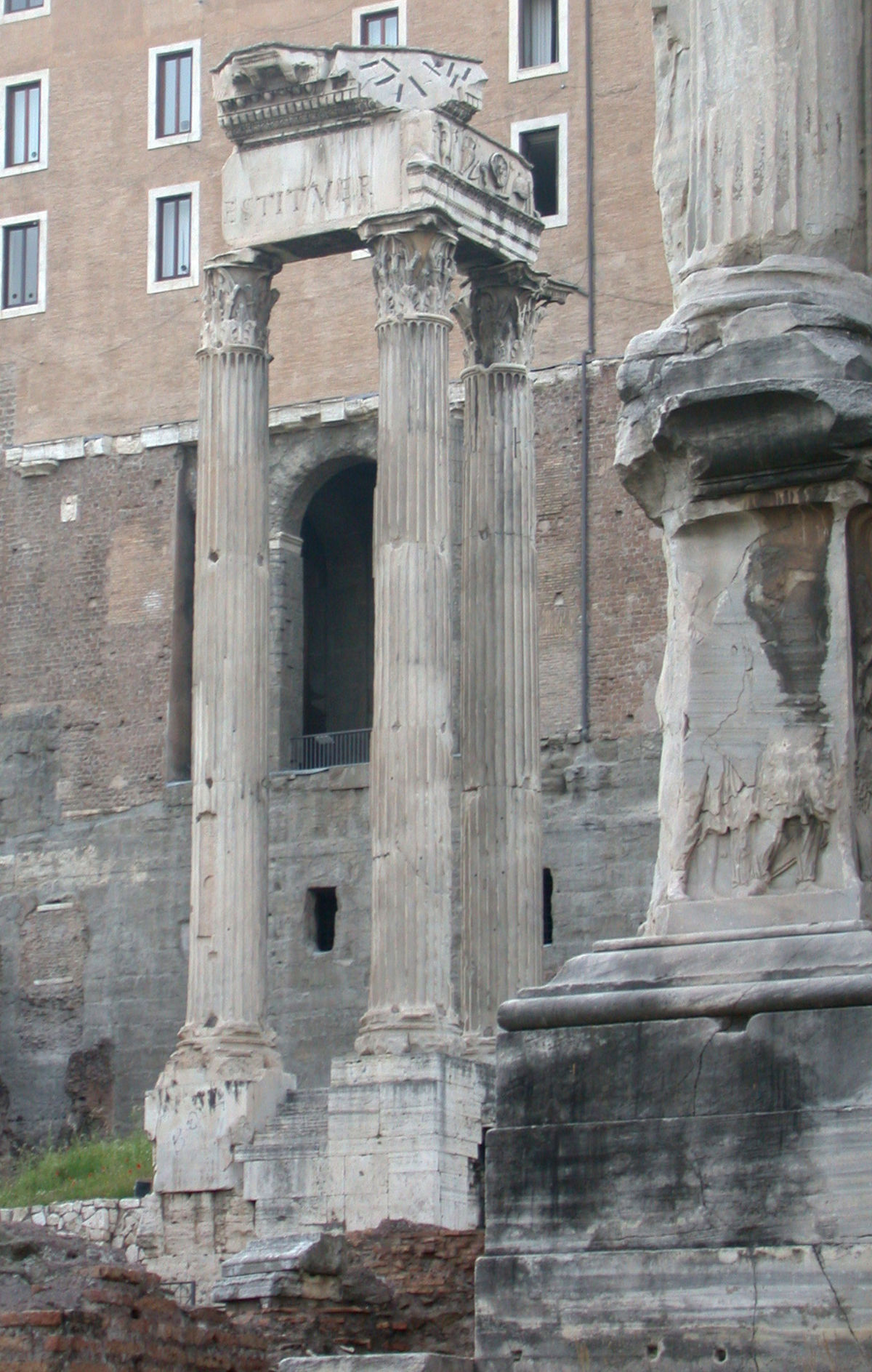
Temple of Vespasian
Europe,
Italy,
citta,
Rione X - Campitelli
Built to honor Emperor Vespasian after his death in 79 AD, the temple was completed by his son Titus and later restored by Domitian, Titus’ younger brother. This monument not only celebrates the deification of Vespasian, but also the importance of the Flavian dynasty in the consolidation of the Roman Empire.
The temple was started by Titus shortly after his father’s death and completed by Domitian in 87 AD. Its construction marked a period of great transformation for the Roman Forum, which saw a series of new constructions and restorations aimed at celebrating the stability and greatness of the Empire under the Flavians. Located next to the Temple of Concord and near the western corner of the Forum, the Temple of Vespasian and Titus occupied a prominent position, emphasizing the importance of the imperial family.The architecture of the temple reflects the skill and attention to detail typical of the Romans. Built on a high podium, the building featured six Corinthian columns on the facade and another six on each long side, supporting an elaborate pediment decorated with reliefs. These columns, about 15 meters high and made of Luna marble, gave the temple a majestic and imposing appearance, visible from much of the Forum.The temple’s cella, the inner sanctuary, housed the deified statues of Vespasian and Titus, alongside various other decorations celebrating their deeds and reign. The walls were clad in precious marbles and decorated with reliefs depicting scenes from Vespasian’s life, including his rise to the throne and his military campaigns, especially in Judea. The cella was accessible via a monumental staircase that added further solemnity to the building.A significant element of the temple was its dedicatory inscription. Originally, the inscription commemorated Vespasian, but with Domitian’s completion of the temple, it was modified to also include Titus. This gesture not only honored both emperors, but also solidified the idea of dynastic continuity and filial piety, fundamental values in Roman society.During the Middle Ages, the temple, like many other Roman monuments, suffered numerous looting and modifications. Its structures were partly dismantled to recover building materials, and the temple fell into ruin. However, the remains of the columns and part of the pediment remained standing, a testament to the durability and magnificence of Roman architecture.In the Renaissance, interest in Roman antiquities led to a renewed study of the temple. Artists and architects, including Andrea Palladio, drew and studied the ruins, seeking to understand Roman construction techniques and aesthetics. These studies deeply influenced Renaissance and Baroque architecture, contributing to the rediscovery and valorization of the ancient heritage.An interesting anecdote concerns the restoration of the temple under Emperor Domitian. It is said that Domitian, known for his vanity and desire to leave a lasting mark, wanted to include his name in the dedicatory inscription of the temple. However, out of respect for his predecessors, he decided not to do so, thus leaving the temple as a monument to the memory of Vespasian and Titus.Today, the remains of the Temple of Vespasian and Titus continue to dominate the landscape of the Roman Forum. The three surviving columns, with their Corinthian capitals and part of the architrave, are among the most photographed and admired monuments in the Forum.
Read More