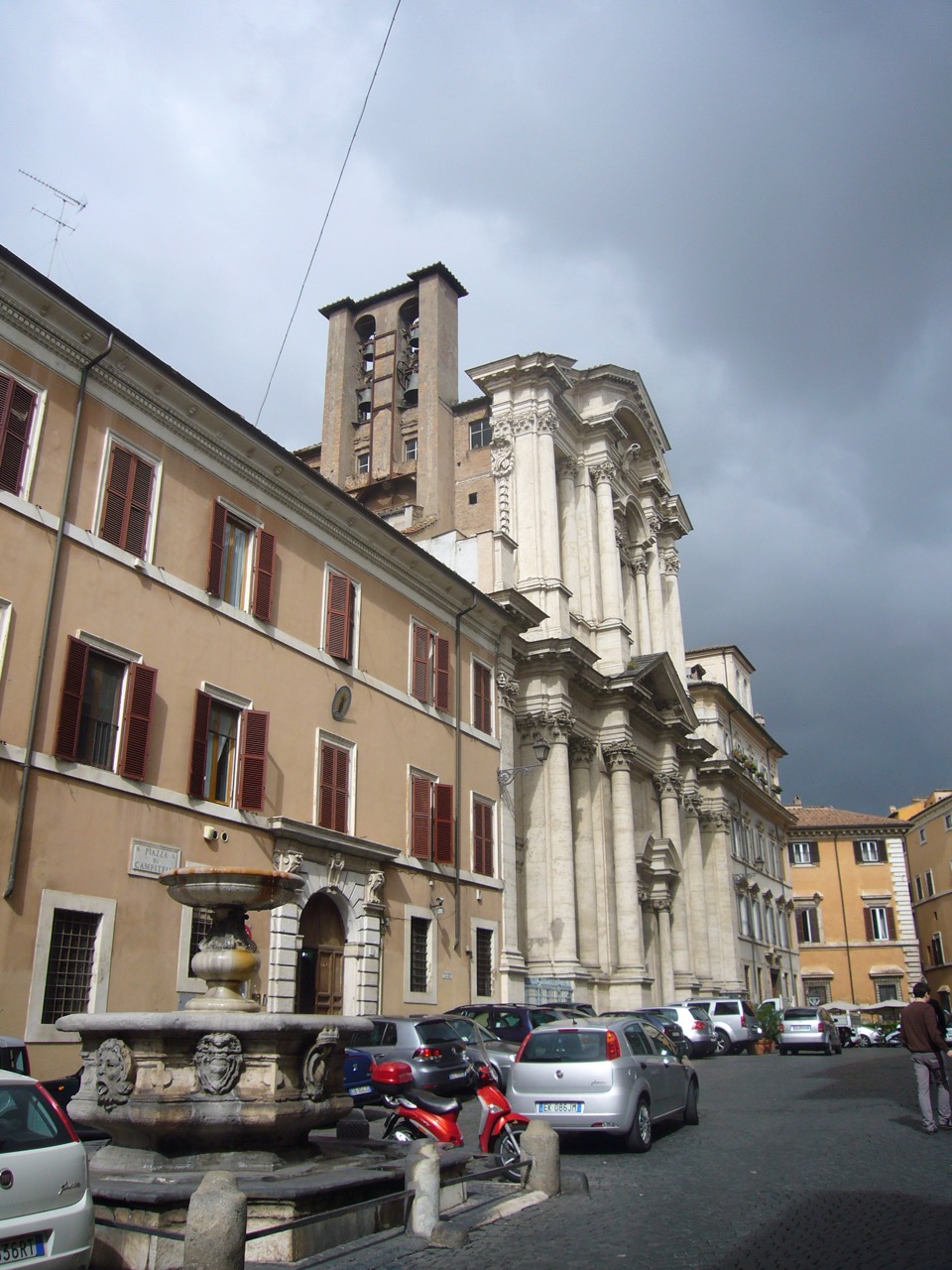
Campitelli square
Europe,
Italy,
citta,
Rione X - Campitelli
Piazza di Campitelli, located in the heart of Rome, is a place rich in history, art, and charm. Its name comes from the Church of Santa Maria in Campitelli, which overlooks the square and represents one of the most important examples of Baroque architecture in the city. The church was built in the 17th century based on a design by Carlo Rainaldi, commissioned by Pope Alexander VII, to replace a previous oratory that housed a miraculous icon of the Madonna, particularly venerated by the Romans.
The facade of the Church of Santa Maria in Campitelli is a masterpiece of Baroque elegance, with Corinthian and composite columns creating a play of light and shadow. The interior of the church is equally impressive, with a main altar hosting the precious icon of the Madonna in a golden glory of angels, clouds, and rays of light, a work reminiscent of the effects used by Bernini in the apse of St. Peter’s. This icon, probably dating back to the 11th century, is considered one of the most sacred treasures of the church.Next to the church is the Fountain of Piazza Campitelli, designed by Giacomo della Porta in 1589 and built by Pompilio De Benedetti. The fountain consists of an octagonal travertine base supporting a cup with the same shape. On the sides of the cup are the coats of arms of the families that financed the construction of the fountain: Capizucchi, Albertoni, Muti, and Ricci. The fountain adds an element of freshness and beauty to the square, which is one of the most picturesque and peaceful corners of central Rome.Piazza di Campitelli is surrounded by historic buildings that tell the rich history of the city. Among these, Palazzo Albertoni Spinola stands out, built in the 17th century, combining Renaissance and Baroque elements in a harmonious architectural ensemble. The Albertoni family, one of the oldest and most influential in Rome, played a significant role in the city’s history, and the palace is a testament to their power and prestige.Another notable building is Palazzo Capizucchi, located at the northeastern end of the square. Built by the Capizucchi family on the houses of the De’ Rossi family, the palace has an elegant facade overlooking the square, adding to its historical charm. The short street leading to Via dei Delfini is named after the Delfini family, who erected their palace here in the 16th century, incorporating a pre-existing residence of the Frangipane family.The square is also associated with numerous historical anecdotes. It was believed, until the mid-20th century, that one of the entrances to the Circus Flaminius complex was located at the northern end of Piazza di Campitelli. However, more recent studies have concluded that the identified remains actually belong to the Crypta Balbi, an adjacent complex to the Theatre of Marcellus and the Portico of Octavia. This change in archaeological understanding highlights how much there is still to discover and interpret about Rome’s ancient history.The square is also close to many other places of historical and artistic interest, such as the Theatre of Marcellus, the Church of Santa Caterina dei Funari, and the Portico of Octavia. This proximity to important archaeological sites and monuments makes Piazza di Campitelli an ideal starting point for exploring Rome’s rich cultural heritage.
Read More