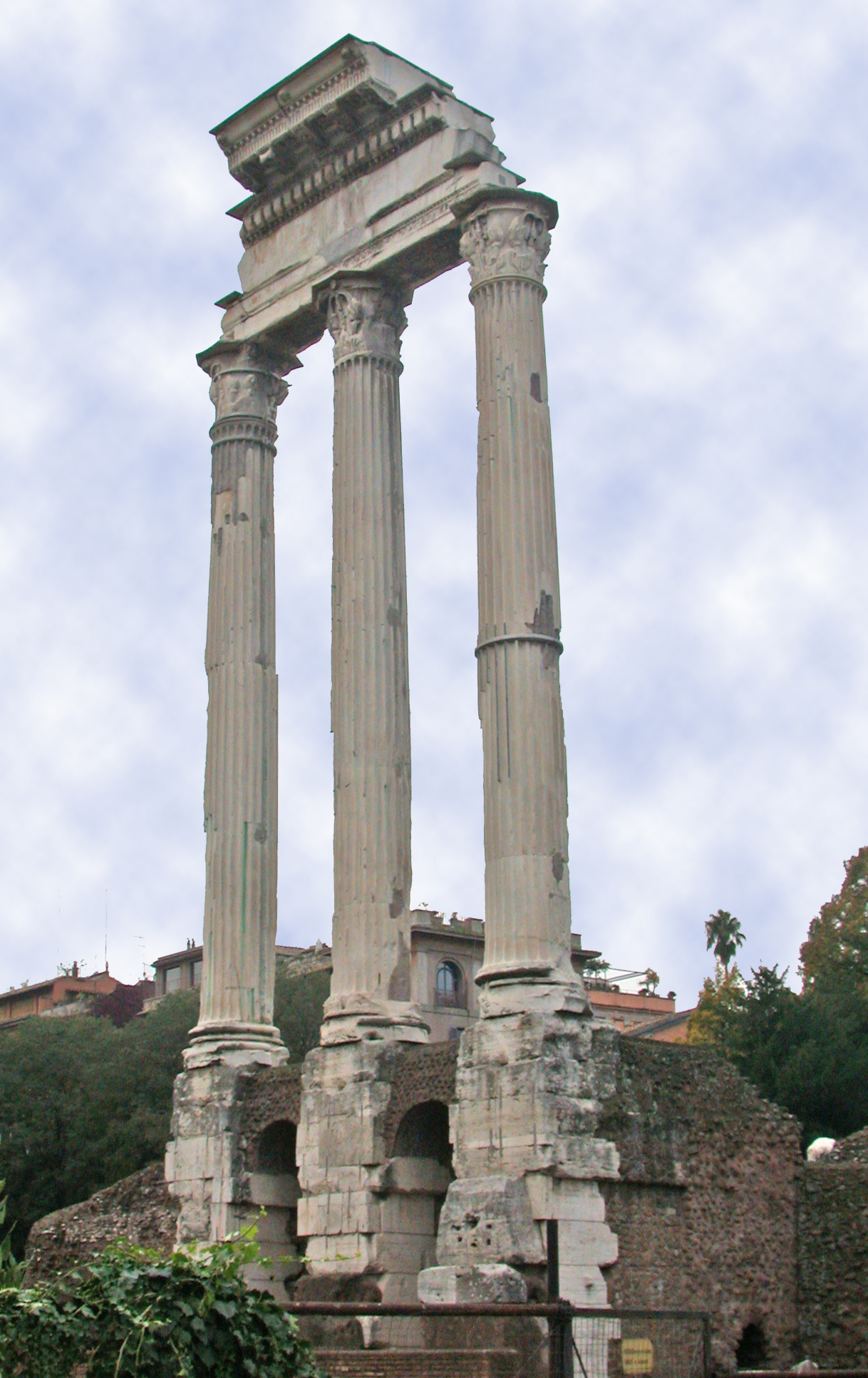
Temple of Castor and Pollux (or of the Dioscuri)
Europe,
Italy,
citta,
Rione X - Campitelli
The Temple of Concord, located in the Roman Forum, is one of the most significant buildings of ancient Rome, both for its historical importance and its architecture. Built for the first time in 367 BC by Lucius Furius Camillus, the temple was dedicated to the goddess Concordia to commemorate the reconciliation between patricians and plebeians, thanks to the Licinian-Sestian laws that allowed plebeians to access the consulate.
The temple was strategically located at the foot of the Capitoline Hill, near the Curia and the Comitium, key places for the political life of the Roman Republic. Its location was symbolic, representing the need for harmony and collaboration between the different social classes of Rome.The original temple suffered numerous damages over the centuries, including a serious fire in 210 BC that destroyed much of the Forum. It was entirely rebuilt in 121 BC by Lucius Opimius, who enlarged it and enriched it with sumptuous decorations to celebrate the renewed concord after the disorders caused by the assassination of the plebeian tribune Tiberius Gracchus. This reconstruction made the temple one of the most imposing buildings in the Forum, with a large cell decorated with Corinthian columns and detailed reliefs.During the imperial era, the temple was further restored under the reign of Augustus, when Tiberius, the future emperor, dedicated the temple in 10 AD after completing the works started by Augustus. This restoration included the addition of a hexastyle pronaos and the use of precious marbles, such as Luna marble and cipollino. The cella was decorated with high-quality sculptures and reliefs depicting mythological and historical scenes.The Temple of Concord was not only a place of worship, but also a political and cultural center. During the late Republic and the Empire, the temple was used for Senate meetings, especially in times of crisis. Here, Cicero delivered one of his most famous speeches against Catiline, urging the Senate to defend the concord and order of the Republic. This use of the temple emphasizes its symbolic importance as a place of peace and social harmony.In the Middle Ages, the temple fell into disuse and many of its structures were dismantled to recover building materials. The columns and marbles were reused in other buildings, and the temple was reduced to a ruin. However, part of the podium and cella foundations survived, testifying to the ancient grandeur of the temple.In the 18th century, during the Grand Tour era, the temple became a must-see destination for European artists and intellectuals, who admired its ruins and studied its architecture. Figures like Goethe and Winckelmann described the temple in their writings, contributing to rediscovering the cultural and historical importance of the building.Today, the remains of the Temple of Concord are visible in the Roman Forum, next to the Tabularium and the Temple of Vespasian. Although only a few traces of the original building remain, the foundations and some marble decorations offer an idea of the magnificence of the temple and its relevance in the history of Rome.
Read More